 The referral pathways guide



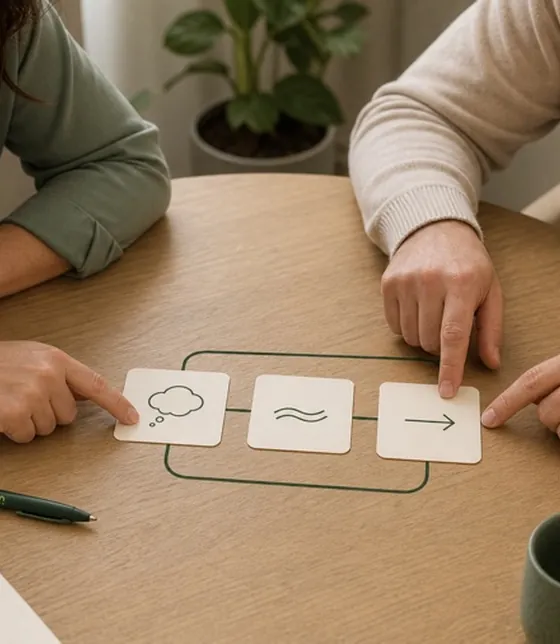 Read with intention













 Meet the clinicians
Change the thoughts that keep you stuck.
CBT is a practical, structured approach that untangles the links between how you think, feel and act, then gives you tools to use in real life.
What CBT helps with
Every plan is tailored to you. This is a guide to where this approach is most often used.
- Anxiety, worry and panicRead more
- Depression and low moodRead more
- OCD and intrusive thoughtsRead more
- Insomnia (CBT-I)Read more
- Stress and burnoutRead more
- Phobias and health anxietyRead more
- Social anxietyRead more
- PTSD and trauma (trauma-focused CBT)Read more
- Bulimia and binge eatingRead more
- Chronic painRead more
- Body image concerns and body dysmorphic disorder
- Bipolar disorder, alongside medical careRead more
Not sure if it's the right fit? That's exactly what your first session is for. We'll recommend the approach (or blend of approaches) that suits you.

Cognitive Behaviour Therapy (CBT) is a family of protocols, not one therapy.
Each of these is a distinct, manualised treatment with its own evidence base. If you have been told to look for a particular one, this is where to check whether it is what you need.
CBT for Anxiety & Depression
Anxiety and depression together
The two arrive together far more often than separately. One integrated course of work on both, rather than treating one and hoping the other follows.
Read more BABehavioural Activation
Depression
Changing what you do before changing how you think: rebuilding activity and reward when motivation has gone.
Read more CBT-ICBT for Insomnia
Chronic insomnia
Sleep restriction, stimulus control and work on the worry that keeps you awake. Recommended ahead of sleeping medication as the first-line treatment.
Read more ERPExposure & Response Prevention
OCD
Meeting the trigger deliberately and not performing the compulsion, in graded steps, until the anxiety comes down on its own. The OCD-specific protocol.
Read more CPTCognitive Processing Therapy
PTSD
Works on the meaning the trauma left behind: the stuck points about safety, trust, control and self-blame. Usually around twelve sessions.
Read more PEProlonged Exposure
PTSD
Approaching the memories and situations avoided since the trauma, at a pace you set, until they stop deciding where you can go.
Read more TF-CBTTrauma-Focused CBT
Children and adolescents after trauma
A staged protocol (coping skills first, then a trauma narrative), with a parent or caregiver worked with alongside the young person.
Read more CBT-CPCBT for Chronic Pain
Persistent pain
The pain is real and the nervous system is trainable. Pacing, graded return to activity, and work on the fear-avoidance cycle that quietly shrinks a life around the pain.
Read moreEnhanced CBT for eating disorders
Anorexia, bulimia and binge eating
Transdiagnostic: it treats the process that keeps an eating disorder going rather than the diagnostic label, so it does not change when the diagnosis does.
Compassion-Focused Therapy
Shame and harsh self-criticism
Builds the capacity to be on your own side. Often what makes the rest of CBT possible when self-attack is the loudest part of the pattern.
Read moreMindfulness-Based Cognitive Therapy
Recurrent depression
An eight-week programme built to prevent the next episode rather than treat the current one, for people who have been depressed more than once.
Unified Protocol
Several emotional disorders at once
One emotion-focused protocol spanning the anxiety, mood and related disorders, instead of a separate manual for each diagnosis, useful when three or four labels apply.
CBT for psychosis
Distressing voices and beliefs
Reduces the distress and interference of voices and unusual beliefs. It sits alongside psychiatric care rather than replacing it.
CBT for substance use
Alcohol and other drug use
Functional analysis of use, coping skills for the high-risk moments, and relapse prevention, usually with motivational work first.
Read more CBT-PDCBT for personality difficulties
Long-standing relational patterns
Longer, schema-informed CBT for patterns that predate the current episode and keep regenerating it.
Read more CBT-OCPDCBT for obsessive-compulsive personality
Perfectionism, rigidity and over-control
Targets perfectionism, over-control and inflexibility, which is a different pattern from OCD, despite the shared name.
Read moreMost of our clinicians work across most of these: CBT is one skill set applied to different problems, not sixteen separate services. Which protocol fits you, and how much of it, is worked out at the first session rather than assumed from a booking form. Intake and triage get you to the right person, at the right depth, first time. Request an appointment.
The approach, step by step.
A clear sense of how the work unfolds, always at your pace.
- 1
Understand the pattern
We map the loop between your thoughts, feelings, body and behaviour, so the problem becomes something you can see clearly rather than just feel.
Early sessions - 2
Test and reshape
Together we examine unhelpful thinking and try small experiments in daily life, gently proving to yourself that another way is possible.
The sessions that follow - 3
Build lasting skills
You leave each block of work with concrete tools you keep for good, so you become your own therapist over time.
Ongoing
Sessions are collaborative and focused. You'll often leave with something small to practise between visits: not homework for its own sake, but the part where real change happens.
Know your costs before you start.
With a Mental Health Treatment Plan from your GP, Medicare rebates apply to individual therapy. We'll always be clear about costs before you begin.
See fees- Medicare: rebates on up to 10 sessions a year with a Mental Health Treatment Plan.
- NDIS, DVA, Workers Comp & CTP: usually no out-of-pocket cost when approved.
- Private health: claim through your extras cover, with no referral needed.
Practitioners who use this approach.




Things people ask before booking.
How many sessions does CBT take?
Is CBT just positive thinking?
Can CBT be done online?
What happens in the first CBT session?
Is CBT covered by Medicare?
What's the difference between CBT and ACT?
Do I need a referral?
References
- Hofmann SG, Asnaani A, Vonk IJJ, Sawyer AT, Fang A. (2012). The efficacy of cognitive behavioral therapy: A review of meta-analyses. Cognitive Therapy and Research, 36(5), 427-440. doi.org/10.1007/s10608-012-9476-1
- Cuijpers P, Miguel C, Harrer M, Plessen CY, Ciharova M, Ebert D, Karyotaki E. (2023). Cognitive behavior therapy vs. control conditions, other psychotherapies, pharmacotherapies and combined treatment for depression: A comprehensive meta-analysis including 409 trials with 52,702 patients. World Psychiatry, 22(1), 105-115. doi.org/10.1002/wps.21069
- Malhi GS, Bell E, Bassett D, Boyce P, Bryant R, Hazell P, Hopwood M, Lyndon B, Mulder R, Porter R, Singh AB, Murray G. (2021). The 2020 Royal Australian and New Zealand College of Psychiatrists clinical practice guidelines for mood disorders. Australian & New Zealand Journal of Psychiatry, 55(1), 7-117. doi.org/10.1177/0004867420979353
Further reading and free tools.
From the Journal
- CBT Sydney: What It Is, Costs & How It Works
- The Anxiety Toolkit: 7 Evidence-Based Strategies
- Cognitive Biases, Heuristics and Distortions Explained
- Cognitive Processing Therapy (CPT) for PTSD
Fact sheets
All fact sheets
Your next step starts here.
Tell us what's going on and we'll match you with the right psychologist, usually after a free triage. No referral needed to begin.
Talk to us
How can we help?
Fees & rebatesFind a psychologistMind Health CheckReferring a clientWorkplaces & EAP
If you need support right now Lifeline 13 11 14 · Suicide Call Back 1300 659 467 · 13YARN 13 92 76 · Emergency 000. Available 24/7 — this panel isn't.
We'll call you back on the number you gave us within one business day. If it's urgent, call 1300 084 200.
