 The referral pathways guide



 Read with intention












 Meet the clinicians
Chronic pain and mental health: How psychology helps with persistent pain

If you have lived with pain for months or years, you will know it rarely stays in one part of your life. It can wear down your sleep, mood, work and relationships. This article is for adults living with persistent pain, and for the people who support them.
It explains how pain, stress, sleep and mood affect one another, how common chronic pain is in Australia, and what pain psychology involves. None of this means your pain is “in your head”. Pain is real. It is produced by a nervous system that responds to what is happening in your body and in your life.
We also cover how psychology sits alongside medical care and physiotherapy, and the main ways to get referred, including Medicare plans and, in NSW, workers compensation and CTP claims.
Key takeaways
- Chronic pain is pain that lasts for at least three months, or beyond the expected healing time. About 1 in 5 Australians aged 45 and over live with it.
- Pain, sleep, stress and mood feed each other. Working on these links does not mean the pain is imagined.
- Pain psychology can include pain education, CBT, acceptance and commitment therapy, pacing, sleep strategies and relaxation skills.
- A review of 75 trials found that CBT has small benefits for pain, disability and distress. It is one part of a plan, not a cure.
- Your GP is the usual starting point for a referral, through a Medicare plan or an injury claim.
What chronic pain is and how common it is
Chronic pain is pain that lasts for at least three months, or beyond the time an injury or illness would normally take to heal.1 It is also called persistent pain, and it is usually felt on most days.1 It can follow an injury or surgery, or come with conditions such as back pain, arthritis, endometriosis, migraine and fibromyalgia. Sometimes no clear cause is found.1
It is common. A national report estimated that 1.6 million Australians aged 45 and over, about 1 in 5, had chronic pain in 2016.2 Across all ages, the national action plan for pain management puts the number at more than 3.24 million people.3 If you live with pain, you are far from alone.
Why pain can continue after the body has healed
Pain normally works as a warning system. Nerves carry signals from the affected part of the body to the brain, and the pain usually settles as the problem heals.1 In chronic pain, the nerves that carry those signals, or the brain itself, can become more sensitive than usual, and the brain may read other signals as pain.1 It is a little like a smoke alarm that has become so sensitive it goes off when you make toast.
This is a real change in how the nervous system handles signals. Pain that persists is not imagined.4 It also helps to explain a common and confusing experience: tests that find no clear cause while the pain carries on.
How pain, stress, sleep and mood affect each other
Pain is now understood as having three overlapping parts: physical, psychological and environmental. This is often called the biopsychosocial model.3 In plain terms, the pain you feel on a given day is shaped by your body (nerves, tissues, fitness, sleep), your mind (attention, worry, mood) and your circumstances (work, money, relationships, support).
The model does not say that thoughts cause pain. It says these parts of life are connected, and that each can turn pain up or down. Many people with pain know this from experience: the same back can feel different after a good night and an easy weekend than it does after a broken night and a tense week. The main links are:
- Pain and sleep: Pain makes it hard to get comfortable, and a poor night can make pain worse the next day. For many people this becomes a vicious cycle.4
- Pain and mood: Chronic pain can increase the risk of anxiety and depression.1 In a 2016 national survey of people aged 45 and over, those with chronic pain were 2.5 times as likely to report a mental health problem as those without it.2 Low mood, in turn, can make pain harder to manage.4
- Pain and stress: Stress and anxiety can affect pain.4 You may notice that pain flares during deadlines, conflict or money worries.
- Pain and activity: Pain can lead people to do less, or to push through on good days and then crash.4 Both patterns can make pain harder to live with, and can reduce contact with the people and activities that lift mood.
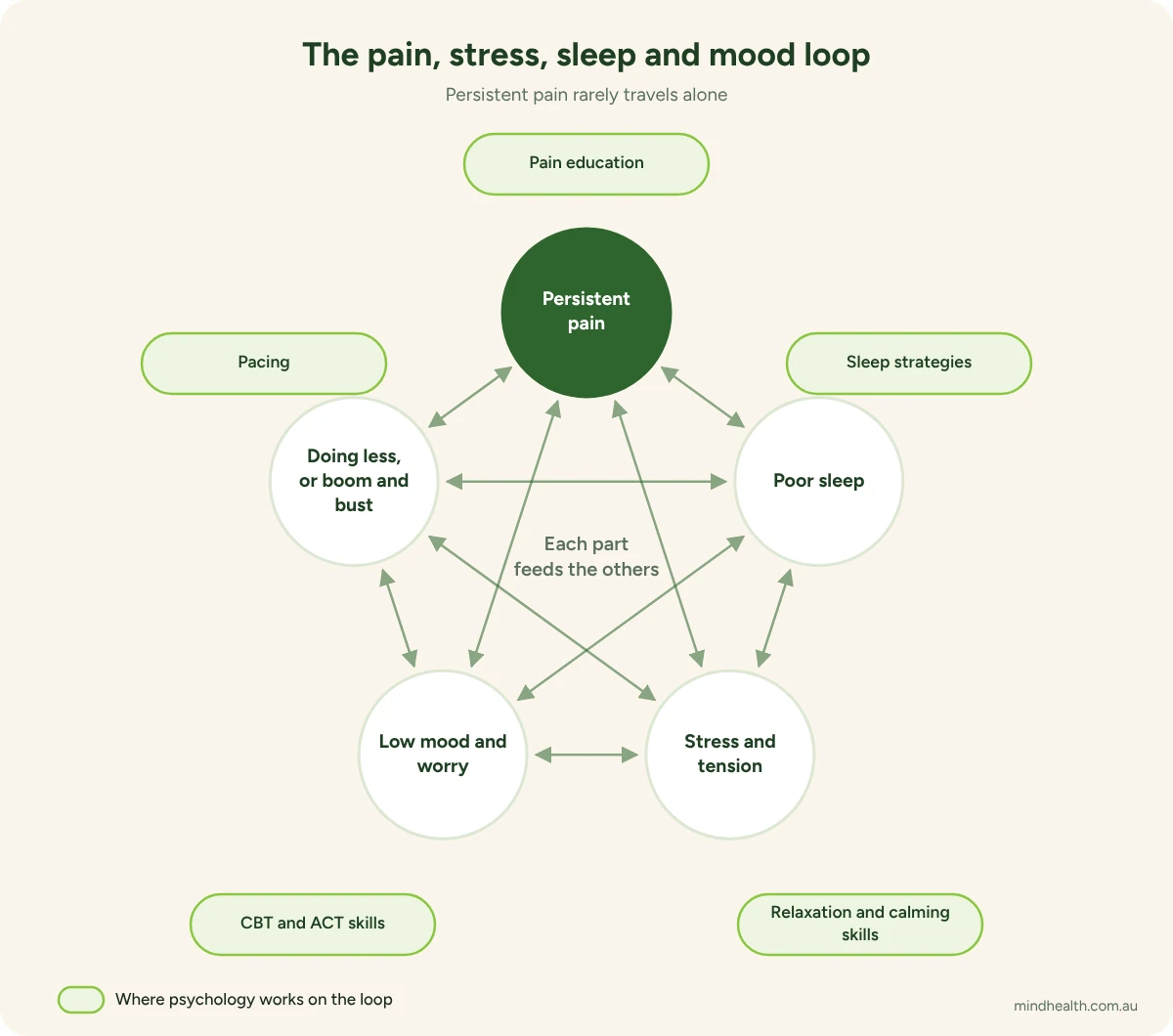
Because each part feeds the others, the loop can be hard to break on your own. It also means there is more than one place to start, which is why most people benefit from a plan that works on several areas together.1 A useful first step is to notice your own loop for a week or two: what your sleep, stress and activity were like before a bad day, and before a better one.
What psychological support for pain involves
A psychologist working with chronic pain is not treating the pain as a mental illness. The first sessions usually look at how pain is affecting your sleep, mood, activity, work and relationships, and at what matters most to you. From there, the work is practical and skills based. It may include:
- Pain education: Learning how the nervous system produces and amplifies pain, and why hurt does not always mean harm.4 Understanding this can make movement feel less threatening.
- Cognitive behavioural therapy (CBT): CBT looks at the links between thoughts, feelings and what you do. For pain, this includes noticing unhelpful patterns of thinking and trying out other ways of responding.4 After a flare-up, for example, “I have ruined my back for good” might become “flare-ups pass, and I have a plan for them”.
- Acceptance and commitment therapy (ACT): ACT focuses less on changing thoughts and more on making room for difficult sensations and feelings, so that you can put your energy into the things you value, such as getting to your child’s game on a sore day.
- Pacing: Breaking activities into smaller steps with planned rests, then building up gradually.14 Rather than mowing the whole lawn on a good day and paying for it for three days, you might do it in two short blocks with a rest between.
- Sleep strategies: Regular bed and wake times, keeping the bedroom for sleep, and having a plan for worries before bedtime.4 A psychologist can adapt sleep strategies to life with pain.
- Relaxation and calming skills: Relaxation, meditation and mindfulness are part of many pain management plans, and can help settle a nervous system that is on high alert.14
- Support with mood and anxiety: Where depression or anxiety sits alongside pain, it is addressed as part of the same plan.
What the research says
Psychological therapy for chronic pain has been tested in many trials, and the benefits found are modest. A review of 75 trials involving 9,401 adults with chronic pain found that CBT had the largest evidence base, with 59 studies.5 It concluded that CBT has small or very small beneficial effects on pain, disability and distress, based mostly on moderate quality evidence.5
For ACT and behavioural therapy there were fewer trials and the evidence was rated moderate to very low quality, so their effects are much less certain.5 The review also found too little information to judge unwanted effects.5
In practical terms, psychological therapy is not a cure for pain, and nobody should promise that it is. For many people chronic pain cannot be cured, and the aim of a management plan is to stop pain from interfering with daily life.1 That is why goals in pain psychology are usually set around daily life and not only a pain score: sleeping more soundly, returning to activities that matter, feeling less ruled by pain.
How psychology fits with medical care and physiotherapy
Psychology does not replace medical care. Medicines alone are not usually enough to manage chronic pain, and most people benefit from a range of treatments and self-management.1 Your team might include:
- Your GP: Assesses the pain, arranges tests and referrals, and helps you develop a plan.1 Any decision about pain medicines is one to make with your doctor.
- A physiotherapist or exercise physiologist: Guides movement, exercise and strengthening.1
- A psychologist: Works with you on the pain, stress, sleep and mood loop, and on pacing.
- A pain clinic: Your doctor may refer you to a pain management program at a pain clinic, available through most major public hospitals and privately.1 These clinics bring together a range of medical and allied health professionals, and pain medicine combines behavioural, psychological and biomedical strategies.6
A physiotherapist may set a graded walking plan, while a psychologist helps with the fear, frustration or all-or-nothing habits that get in the way of following it. With your consent, our psychologists keep your GP informed.
How to get a referral
You can contact a psychologist directly, but a referral is needed for sessions funded through Medicare,7 and for psychology under a NSW workers compensation claim.8 Your GP is the usual first step. Tell your GP how pain is affecting your sleep, mood and daily life, not only where it hurts.
- Mental Health Treatment Plan (MHTP): A GP can prepare an MHTP for a person with a diagnosed mental health condition.7 Pain on its own is not the basis for this plan, but conditions such as depression or anxiety that occur with pain may be. Medicare benefits are available for up to 10 individual sessions per calendar year, starting with a course of up to 6 followed by a review.7 The plan generally needs to come from your usual GP or the practice where you are registered for MyMedicare.7 See our guide to getting a Mental Health Treatment Plan.
- GP chronic condition management plan: These plans replaced GP Management Plans and Team Care Arrangements on 1 July 2025.9 They are for people with a condition that has been, or is likely to be, present for at least six months.9 They allow up to five individual allied health services per calendar year in total, which for chronic pain may include psychology or exercise physiology.9
- Workers compensation (NSW): If your pain follows a work injury, a psychologist needs a referral from your nominated treating doctor, and the insurer decides whether treatment is reasonably necessary.8 See our workers compensation page.
- CTP claims (NSW): After a motor vehicle crash, the insurer pays for reasonable and necessary treatment and care related to the accident for most claimants, which can include psychology and physiotherapy.10
These rules change from time to time, so check the current details with your GP or insurer.
When to see your GP or a psychologist
Any pain that worries you is worth raising with your doctor.1 See your GP if:
- pain has lasted more than three months, or well beyond the time you were told to expect
- the pain is new, changing or spreading, or has not been assessed
- pain is affecting your sleep, work, mood or relationships
- you have questions about pain medicines, which are decisions to make with your doctor.
Consider seeing a psychologist if:
- you feel flat, irritable, anxious or hopeless about the pain
- you avoid movement or activities because you fear making things worse
- you swing between overdoing it and being laid up for days
- sleep has become a nightly struggle
- pain has cut you off from work, friends or the things you used to enjoy.
If your pain changes suddenly, or your mood drops to the point where you are struggling to cope, see your GP promptly.
Frequently asked questions
Does seeing a psychologist mean my pain is all in my head?
No. Chronic pain involves real changes in how the nerves and brain handle signals, and pain that persists is not imagined. Psychology is part of pain care because sleep, stress, mood and activity all affect how the nervous system handles pain. Working on those areas takes pain seriously.
Can psychological therapy cure chronic pain?
It is not a cure. A 2020 review of 75 trials found that cognitive behavioural therapy has small or very small benefits for pain, disability and distress. For many people, the aim is to reduce how much pain interferes with sleep, work and daily life, alongside medical care and physiotherapy.
Can I use a Mental Health Treatment Plan for chronic pain?
A Mental Health Treatment Plan is for people with a diagnosed mental health condition, as assessed by a GP. Pain alone is not the basis for one, but depression or anxiety that occurs with pain may be. A GP chronic condition management plan is another option. Your GP can advise which fits.
What is pacing?
Pacing means breaking activities into smaller steps with planned rests, then building up gradually over time. It is used to replace the pattern of doing too much on good days and then crashing. A psychologist or physiotherapist can help you set starting points that suit your pain and your routine.
Can I see a psychologist while I am seeing a physiotherapist or attending a pain clinic?
Yes. Most people with chronic pain benefit from a range of treatments, and pain clinics themselves bring several professions together. A psychologist can work on sleep, stress, mood and pacing while your physiotherapist guides movement and your doctor manages medical care. With your consent, they can share information.
References
- healthdirect Australia. (2025). Chronic pain. Last reviewed March 2025. https://www.healthdirect.gov.au/symptoms/aches-and-pains/chronic-pain
- Australian Institute of Health and Welfare. (2020). Chronic pain in Australia (Cat. no. PHE 267). AIHW. https://www.aihw.gov.au/reports/chronic-disease/chronic-pain-in-australia/summary
- Australian Government Department of Health. (2021). The National Strategic Action Plan for Pain Management. Commonwealth of Australia. https://www.health.gov.au/resources/publications/the-national-strategic-action-plan-for-pain-management
- NSW Agency for Clinical Innovation. (n.d.). Pain Management Network: Chronic pain. NSW Health. https://aci.health.nsw.gov.au/chronic-pain
- Williams, A. C. de C., Fisher, E., Hearn, L., & Eccleston, C. (2020). Psychological therapies for the management of chronic pain (excluding headache) in adults. Cochrane Database of Systematic Reviews, 2020(8), CD007407. https://doi.org/10.1002/14651858.CD007407.pub4
- Faculty of Pain Medicine, Australian and New Zealand College of Anaesthetists. (n.d.). What do specialist pain medicine physicians do? ANZCA. https://www.anzca.edu.au/patient-information/about-pain-medicine/what-do-specialist-pain-medicine-physicians-do
- Australian Government Department of Health, Disability and Ageing. (2025a). Fact sheet for patients: Better Access to Psychiatrists, Psychologists and General Practitioners through the MBS initiative. https://www.health.gov.au/sites/default/files/2025-10/better-access-fact-sheet-patients_0.pdf
- State Insurance Regulatory Authority. (2025). Workers compensation guide for allied health practitioners. NSW Government. https://www.sira.nsw.gov.au/resources-library/workers-compensation-resources/publications/health-professionals-for-workers-compensation/workers-compensation-guide-for-allied-health-practitioners
- Australian Government Department of Health, Disability and Ageing. (2025b). Medicare Benefits Schedule: Note AN.0.47, GP chronic condition management plans. MBS Online. https://www9.health.gov.au/mbs/fullDisplay.cfm?type=note&q=AN.0.47
- State Insurance Regulatory Authority. (n.d.). A guide for people injured in a motor crash in NSW. NSW Government. https://www.sira.nsw.gov.au/resources-library/motor-accident-resources/publications/injury-advice-centre/guide-for-people-injured-in-motor-accidents-in-nsw
Related reading
- How to sleep better: 12 science-backed tips for the best snooze
- What is ACT? Acceptance and commitment therapy explained (and who it helps)
- The science of stress management: Complete guide 2026
This article is general information only and is not a substitute for personal advice from a qualified health professional. If you are concerned about your mental health, please speak with your GP or a psychologist.
Free · 5 to 10 minHow are you going, really?Take the Mind Health Check: a few short questions, then a private report.
More on wellbeing & self.
 Wellbeing & Self
AI companions: When a chatbot becomes your 2am confidant
Why people confide in AI chatbots at 2am, what the research and Australia's new rules say, and how…
 Bülent Ada12 min
 Wellbeing & Self
Together we thrive: Connection and Mental Health Month 2026
The 2026 Mental Health Month theme is Together We Thrive. Here is what the evidence says about loneliness,…
Mind Health team10 min Wellbeing & Self
Men’s mental health in Australia: Breaking down the barriers to getting help
Why do Australian men struggle to seek help? A psychologist explains the barriers, the warning signs, and practical…
Mind Health team8 min
Your next step starts here.
Tell us what's going on and we'll match you with the right psychologist, usually after a free triage. No referral needed to begin.
