 The referral pathways guide


 Read with intention












 Meet the clinicians
The under-16 social media rules, nearly a year on: What we know and what still helps

It is 9.40 on a school night. Your 14-year-old says the phone is “just for the group chat”, a video is playing somewhere under the doona, and you catch yourself thinking: wasn’t this meant to have stopped last December?
Since 10 December 2025, social media platforms in Australia have had to take reasonable steps to stop under-16s from holding accounts.1 With the first anniversary approaching, many parents and carers are unsure what has changed in their own home, and whether it has helped.
This article is for parents and carers of children and teenagers. It covers what the rule requires and of whom, what has happened since, what the first studies do and do not show, and what still helps at home. Our earlier parents’ guide to the minimum age gives the background. This is the follow-up.
Key takeaways
- The rule applies to platforms, not families. There are no penalties for under-16s or for their parents and carers.
- Ten platforms are treated as age-restricted. Messaging, online gaming, education and health services are excluded, and public content that needs no login can still be viewed.
- Three months in, most under-16s in two studies were still using social media, often because the platform had not checked their age.
- Early research found no significant change in children’s sleep, wellbeing or distress. It is too early to say whether the rule helps or harms.
- Sleep, phones out of bedrooms, offline connection and calm conversations still matter. If a teenager is struggling for more than a few weeks, see a GP or psychologist.
What the rule requires, and of whom
The law is often called a ban, but it is narrower than that word suggests. It places one duty on certain platforms: take reasonable steps to prevent Australians under 16 from having an account.1
- Who is responsible: The platforms. There are no penalties for under-16s who access an age-restricted platform, or for their parents or carers. A message demanding that a family pay a fine is a scam.1
- Which platforms: Ten are treated as age-restricted: Facebook, Instagram, Kick, Reddit, Snapchat, Threads, TikTok, Twitch, X and YouTube.12 The list can change as services are assessed or reassessed.1
- What is left out: Services whose sole or main purpose is messaging, email or calling, online gaming, or supporting education or health are excluded. Messenger, WhatsApp, Discord, Roblox, YouTube Kids and Google Classroom are among the services not treated as age-restricted.1
- Watching without an account: Under-16s can still see public content that does not need a login, which includes most YouTube videos.1
- No permission slip: A parent cannot consent to an account on a child’s behalf. Platforms are not allowed to let under-16s create or keep one.1
- Age checks: Platforms cannot insist on government ID. They must offer a reasonable alternative way to show age.1
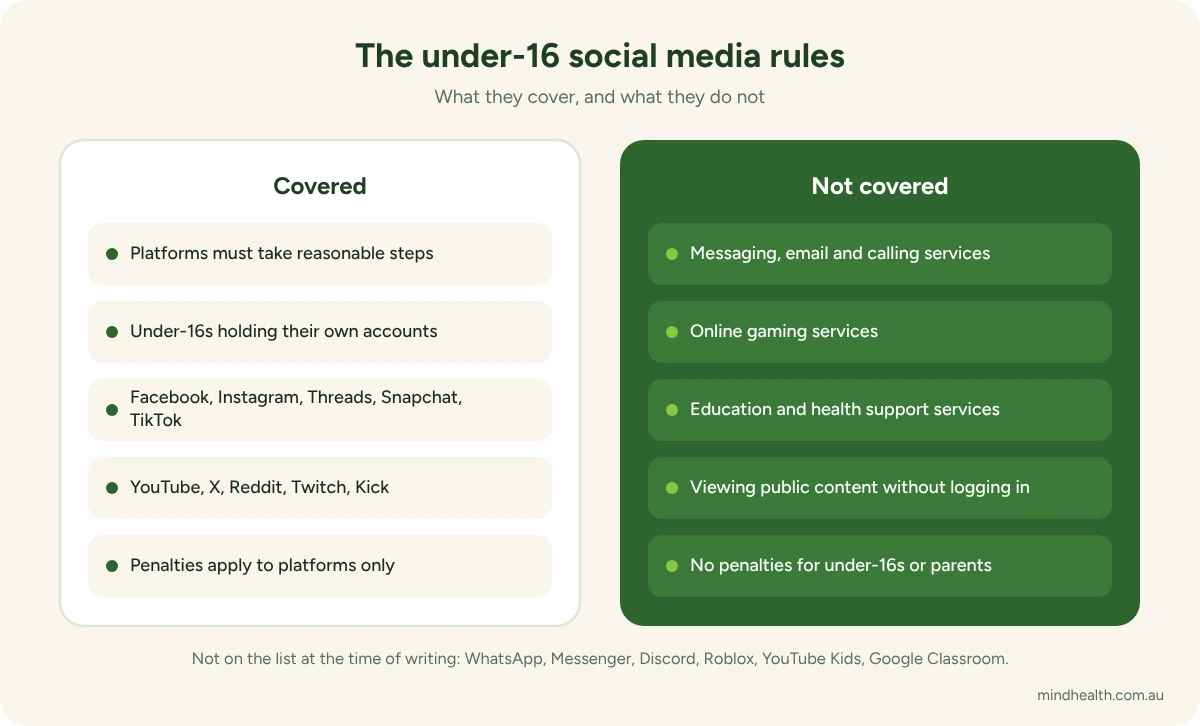
So a 13-year-old watching YouTube on the family TV without signing in, messaging a cousin on WhatsApp or playing Roblox is outside the rule. The same child holding a TikTok or Snapchat account is what platforms are meant to prevent.1
What has happened since December
About 4.7 million accounts had been removed or restricted by mid-December 2025,2 and by late June 2026 the federal government put the total at more than 5 million.3 Those figures count accounts, not children, and the regulator has said they do not show on their own whether a platform is complying.2
The eSafety Commissioner’s first compliance update, in March 2026, raised concerns about gaps. Some platforms prompted users who had already said they were under 16 to try an age check again, some allowed many repeat attempts, and some relied on a typed-in birthday at sign-up. Parents found it hard to report an underage account.2 Five platforms were placed under investigation: Facebook, Instagram, Snapchat, TikTok and YouTube. The update described these as concerns that needed more evidence, not findings that the law had been broken.2
Since then the pressure has grown on platforms, not on families:
- Bigger penalties: In June 2026 the government announced it would double the maximum penalty, from $49.5 million to $99 million, and give the regulator stronger powers to demand evidence from platforms and from third parties such as age assurance providers.3 The department now gives the maximum as $109.2 million.11 The amending Act became law in September 2026.4
- Enforcement: The government has said it is preparing a court case against platforms.5
- A constitutional challenge: In early November 2026 the High Court heard a two-day challenge brought by Reddit and an advocacy group, who argue the law burdens the implied freedom of political communication. A decision is expected in the coming months.5
Are under-16s actually off social media?
Mostly not yet, on the early numbers. The official evaluation, run by the regulator with university researchers, is following more than 4,000 children and a parent of each. Its first report compared 803 children aged 10 to 15 just before the rule began and about three months later.6
- Accounts fell modestly: The share holding an account on an age-restricted platform dropped from 52.4% to 42.1%.6
- Use fell only slightly: 81.5% had used one of the platforms in the previous four weeks, with or without an account, down from 85.9%.6
- The usual reason was not a clever workaround: Among children who still had an account, half said the platform had not asked them to confirm their age. About 11% said a parent had helped them get around the restriction, and 7.4% had used a VPN.6
An independent study in a medical journal reached a similar conclusion. It followed 408 adolescents for about three months and found more than 85% of the under-16s still using the covered platforms, with little evidence of an immediate, substantial drop in use.7 Daily use among 14 and 15-year-olds went from 78% to 69%, but the study was small and relied on self-report, so that shift should be read with caution.7
One finding deserves a parent’s attention. Among children who had used social media in the previous four weeks, the share whose parent did not know rose from 23.3% to 33.3%, a change seen among parents of girls and of 10 to 12-year-olds.6 The researchers offer several possible explanations, and one is that some children are telling adults less.6 A child who feels they must hide an account may also hide the thing that went wrong on it.
What early research says about wellbeing, sleep and connection
This is the question most parents want answered, and it is too early to know.
- Sleep and mood: At three months, the evaluation found no significant change in children’s sleep quality, wellbeing, self-esteem or psychological distress.6 With most children still holding accounts, the researchers say it is not yet possible to judge whether the rule can deliver what it was designed to do.6
- Connection: Daily use of messaging apps rose from 40.5% to 52.3% of children, which may mean many kept in touch another way.6 In written comments, some children described feeling left out or finding friends and relatives harder to reach. Others described less pressure and more time with family.6
- How it felt: Before the rule, 43.8% of children expected it to affect them badly. Three months in, 65.4% said it had made no difference, 19.9% reported a negative effect and 11.5% a positive one.6
- Moving elsewhere: There were small rises in online gaming and in some other platforms such as Pinterest, though it is unclear whether that is displacement or ordinary fluctuation.6 In the journal study, more adolescents reported an increase than a decrease in messaging and in outdoor play. That study did not measure sleep or mental health.7
A separate Australian survey of 365 young people aged 10 to 15, taken just before the rule began, found that those who had started using social media at a younger age reported more symptoms of anxiety and depression.8 It is a single snapshot, so it cannot show that early use caused those symptoms, and it says nothing yet about the effect of the law.8
What is missing? Results beyond three months, measures of exposure to online harms, and any reliable sign of whether young people’s mental health improves, worsens or stays the same. Longer follow-ups are planned in both studies.67 Until they report, anyone who says the rule has clearly worked, or clearly failed, is ahead of the evidence.
What still helps at home, whatever the law says
A law aimed at platforms was never going to do the work of a household.
Protect sleep first
Australian guidelines recommend 9 to 11 hours of uninterrupted sleep a night for children aged 5 to 13 and 8 to 10 hours for those aged 14 to 17, with consistent bed and wake times. They also advise avoiding screens in the hour before sleep and keeping screens out of the bedroom.9
- Charge every phone in the kitchen overnight, adults’ phones included.
- Buy a cheap alarm clock, so “I need it for my alarm” stops being the reason the phone stays in bed.
- Agree on the charging time on a calm afternoon, not at 10 pm mid-argument. Our guide on how to sleep better has more ideas.
Keep the conversation going
The official advice is calm, ongoing conversation, not a single showdown, and “not yet” is a fair answer to a child who wants an account.1
- Ask what they enjoy online and who they talk to before you ask what should stop.
- Say it out loud: “If something goes wrong online, on any app, you will not be in trouble for telling me.” The law backs you up here, because it carries no penalties for under-16s.1
- Talk about your own scrolling too. Teenagers notice when rules only run one way.
Make offline connection easy
Friendship is most of what social media offers a teenager, so taking away an app and putting nothing in its place rarely goes well. Say yes to the lift to training, the friend who stays for dinner, the weekend job, the family meal with phones in another room. The same guidelines suggest no more than two hours a day of recreational screen time, not counting schoolwork.9 Treat that as a direction to head in, not a test to pass.
Notice the teenager, not only the phone
Low moods, poor motivation and patchy sleep are common in the teenage years and do not always signal a problem.10 Signs worth watching include seeming down or tearful, trouble sleeping or eating, falling grades or refusing to go to school, pulling away from friends, frequent headaches or stomach aches, and unusual irritability.10 If signs like these continue for more than a few weeks, it is time to talk with your child and seek professional advice.10
What psychological support involves
When a family comes to us about a teenager’s mood, worry, sleep or life online, the first step is an assessment, not a verdict on their phone. A psychologist asks about sleep, school, friendships, family life and what is happening online and offline. A first session usually includes a parent or carer.
From there, support might include:
- Skills for worry and low mood: Approaches such as cognitive behavioural therapy (CBT) help a young person notice unhelpful thinking habits and practise different responses.
- Sleep routines: Practical work on wind-down time, bedtimes and where devices live overnight.
- Parent sessions: Help to set limits that are firm and fair while keeping the relationship warm.
Our psychologists work with teenagers from 13, young adults, and parents and carers, in Parramatta or by telehealth. Our families page has more detail. For a younger child, your GP can suggest a suitable service.
When to see your GP or a psychologist
Consider making an appointment if:
- The signs above have lasted more than a few weeks, or are getting in the way of school, sleep or friendships.10
- Arguments about devices have become constant and nothing you try is working.
- Something distressing has happened online, such as bullying, and your child is not bouncing back.
Your GP is a sound first step. A GP can arrange a mental health assessment and, where appropriate, prepare a Mental Health Treatment Plan (MHTP) with a referral to a psychologist.10 A school counsellor is another good person to talk to.10
If you are worried about your child’s immediate safety, please seek help promptly.
Frequently asked questions
Can my child or I be fined if they still have an account?
No. The rule places the duty on platforms, which must take reasonable steps to stop under-16s from holding accounts. There are no penalties for under-16s who use an age-restricted platform, or for their parents or carers. A message asking a family to pay a fine is a scam. Your child can always tell you if something goes wrong online.
Is YouTube banned for under-16s?
Not entirely. YouTube is on the list of age-restricted platforms, so under-16s are not meant to hold their own account. Public videos that can be watched without logging in are still available to them, and YouTube Kids is not treated as age-restricted. The practical difference is whether your child is signed in to an account of their own.
Has the rule improved teenagers’ mental health?
It is too early to say. The first evaluation report, about three months in, found no significant change in children’s sleep, wellbeing, self-esteem or psychological distress, at a time when most children still held accounts. An independent journal study did not measure mental health. Longer follow-ups are planned, so firm claims in either direction are ahead of the evidence.
My child still has an account. What should I do?
Start with a calm conversation, not a punishment. Many children still have accounts because the platform has not checked their age, and there are no penalties for families. Ask what they use it for and who they talk to, agree on where phones go at night, and make sure they know they can tell you if something goes wrong.
When should I worry about my teenager’s mood?
Low moods and patchy sleep are common in the teenage years and do not always signal a problem. Signs such as seeming down, pulling away from friends, refusing school, or trouble sleeping or eating are worth acting on if they continue for more than a few weeks. Talk with your teenager and see your GP, who can arrange an assessment.
References
- eSafety Commissioner. (2025). Social media ‘ban’ or delay FAQs. Australian Government. Last updated 11 December 2025. https://www.esafety.gov.au/about-us/industry-regulation/social-media-age-restrictions/faqs
- eSafety Commissioner. (2026). Social Media Minimum Age: Compliance update, March 2026. Australian Government. https://www.esafety.gov.au/sites/default/files/2026-03/SocialMediaMinimumAgeComplianceUpdateMarch2026.pdf
- Prime Minister of Australia & Minister for Communications. (2026, 28 June). Stronger powers and double the penalties for world-leading social media law [Media release]. Australian Government. https://www.pm.gov.au/media/stronger-powers-and-double-penalties-world-leading-social-media-law
- Online Safety Amendment (Strengthening Enforcement for the Social Media Minimum Age) Act 2026 (Cth), No. 83, 2026. Federal Register of Legislation. https://www.legislation.gov.au/C2026A00083
- Al Jazeera, Reuters & The Associated Press. (2026, 4 November). Australian government defends social media ban for under 16s in court. Al Jazeera. https://www.aljazeera.com/news/2026/11/4/australian-government-defends-social-media-ban-for-under-16s-in-court
- eSafety Commissioner. (2026). Early days, early insights: Understanding experiences of social media age restrictions at the three-month follow-up. Australian Government. https://www.esafety.gov.au/sites/default/files/2026-07/Early-days-early-insights-SMMA-evaluation-three-months-July-2026.pdf
- Barnes, C., Hall, A., Mantach, S., Oldmeadow, C., Attia, J., Backholer, K., Williams, C., Tefera, Y., Kay, F., & Wolfenden, L. (2026). Assessing early effects of Australia’s Social Media Minimum Age Act on adolescents’ social media use: Observational study. BMJ, 393, e363695. https://doi.org/10.1136/bmj-2026-363695
- Bilston, A., Brown, L., Qi, X., Werner-Seidler, A., & Schweizer, S. (2026). Planned social media ban and depression and anxiety in adolescents. JAMA Network Open, 9(8), e2631107. https://doi.org/10.1001/jamanetworkopen.2026.31107
- Australian Government Department of Health, Disability and Ageing. (n.d.). Physical activity and exercise guidelines for all Australians: For children and young people (5 to 17 years). https://www.health.gov.au/topics/physical-activity-and-exercise/physical-activity-and-exercise-guidelines-for-all-australians/for-children-and-young-people-5-to-17-years
- Raising Children Network (Australia). (n.d.). What is pre-teen and teenage mental health? https://raisingchildren.net.au/pre-teens/mental-health-physical-health/about-mental-health/teen-mental-health
- Department of Infrastructure, Transport, Regional Development, Communications, Sport and the Arts. (n.d.). Social media minimum age. Australian Government. Retrieved 18 November 2026, from https://www.infrastructure.gov.au/media-communications/internet/online-safety/social-media-minimum-age
Related reading
- Nurturing empathy in teenagers: A parent’s guide
- HSC exam stress: A guide for students and parents in NSW
- What is digital burnout? 7 evidence-based strategies
- AI companions: When a chatbot becomes your 2am confidant
This article is general information only and is not a substitute for personal advice from a qualified health professional. If you are concerned about your mental health, please speak with your GP or a psychologist.
Free · 5 to 10 minHow are you going, really?Take the Mind Health Check: a few short questions, then a private report.
More on relationships & family.
 Relationships & Family
Under-16 social media minimum age: A parent’s mental health guide
A calm guide for parents to Australia's under-16 social media minimum age: what the law does, what the…
Mind Health team10 min Relationships & Family
Setting boundaries: A psychologist’s guide to saying no
A Sydney psychologist’s guide to setting healthy boundaries, what to say, how to handle guilt, types of boundaries,…
 Bülent Ada10 min
 Relationships & Family
School refusal: A psychologist’s guide for parents when children won’t go to school
What to do when your child won’t go to school. A psychologist explains emotionally-based school avoidance, what helps,…
Mind Health team8 min
Your next step starts here.
Tell us what's going on and we'll match you with the right psychologist, usually after a free triage. No referral needed to begin.
