 The referral pathways guide



 Read with intention













 Meet the clinicians
OCD treatment that breaks the loop.
Checking, washing, counting, replaying. OCD shrinks life one ritual at a time. Exposure and response prevention helps you take that time back, in Parramatta or online.
OCD is more than liking things tidy.
It’s a loop of intrusive thoughts and rituals that steals time and peace. You don’t need to tick every box, or any box, to reach out.
- Unwanted thoughts or images arrive on repeat. They are disturbing, sticky, and nothing like you.
- You check locks, switches, taps and sent emails more times than you can explain.
- Washing or cleaning eats into the day, and the relief never lasts.
- Things must feel “just right”, ordered, symmetrical and even, before you can move on.
- You replay conversations or mentally review events to be certain nothing went wrong.
- You ask the people around you for reassurance, again and again, and it helps less each time.
- You avoid places, objects or people that set the thoughts off.
- Part of you knows the fear is out of proportion, but knowing doesn’t switch it off.
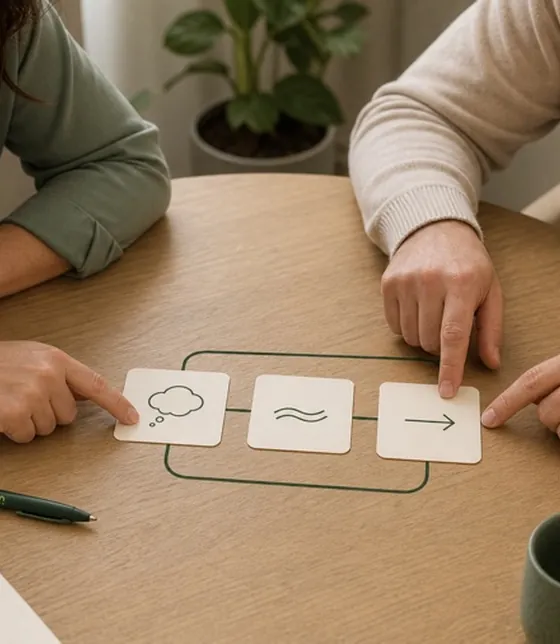
The loop has a logic. An intrusive thought spikes anxiety, a ritual brings relief, and the relief teaches your brain to run the loop again. That’s not a character flaw. It’s a well-understood pattern. Our free OCI-R self-check takes about four minutes and gives a confidential result on the spot. It’s information, not a diagnosis. If distress ever feels bigger than you can hold, our urgent help page lists people you can talk to right now.


ERP first, explained as we go.
Exposure and response prevention is the backbone of what we do. Around it, your psychologist tailors the approach to you.
ERP
Exposure and response prevention means approaching triggers step by step while resisting the ritual, so anxiety settles on its own and the obsession loses its grip.
CBT
Cognitive behaviour therapy unpacks the meaning OCD attaches to intrusive thoughts, and tests the beliefs that make rituals feel necessary.
ACT
Acceptance and commitment therapy helps you practise a different relationship with uncomfortable thoughts while reclaiming time for what matters to you.
GP & medication liaison
Where medication is worth considering, we coordinate with your GP or psychiatrist. The choice stays yours.
We work with presentations including contamination and washing, checking, symmetry and ordering, taboo intrusive thoughts, mental rituals and hoarding. Exposure is always gradual and agreed together. If you’d like to read more first, our Journal guide to OCD symptoms, types and treatment is a good place to start.
ERP, step by step.
ERP is the main part of most OCD treatment here. This is what it involves.
Mapping the cycle
You and your psychologist list the obsessions, the compulsions and the things you avoid, and how they feed each other.
Building a ladder
Together you rank situations from easier to harder. Every step is agreed before you try it.
Practising
You face a step without doing the compulsion, first in a session and then at home, and notice what happens to the anxiety over time.
Reviewing
Each session looks at what you tried and what comes next. You can slow down at any point.
Who offers ERP here: Bülent Ada.

Your first weeks, step by step.
No surprises, no pressure, and no exposure work in session one.
- 1
Mostly a conversation
Your psychologist asks what the thoughts and rituals look like, how much time they’re taking, and what you’d like back. You only share what you’re comfortable sharing.
Session one - 2
Mapping the loop
Together you’ll map your triggers, obsessions and rituals, then build a step-by-step ladder, starting with situations that feel challenging but doable.
Sessions two to four - 3
Practising and reviewing
ERP practice between sessions is where change happens. Progress is reviewed against your goals rather than a fixed program, and the pace stays yours.
Ongoing
Know your costs before you start.
We confirm your fee and any rebate in writing before your first session. If a funding body covers you, we bill them directly wherever possible.
See fees- Medicare: rebates on up to 10 sessions a year with a Mental Health Treatment Plan from your GP.
- NDIS, DVA, Workers Comp & CTP: usually no out-of-pocket cost when approved.
- Private health: claim through your extras cover, with no referral needed.
Meet our clinicians.

Bülent Ada
Principal Psychologist & Director
Anxiety · Trauma

Sijal Ansari
Clinical Psychologist
Trauma · PTSD

Mohan Shankarappa
Clinical Psychologist
Depression · Mood

Michael L. T. Cheung
Consultant Psychologist
Stress · Couples

Shahim Ahmad
Clinical Psychologist
Stress · Anxiety

Irfan Yigit
Senior Consultant Psychologist
Anxiety · Depression


Check in with yourself.
Free, private tools to try before or alongside sessions. They are not a diagnosis.
Free · 5 to 10 min
Take the Mind Health Check
Short questionnaires, scored privately in your browser. We have ticked the ones most related to this page, and you can change them.
Fact sheet: Intrusive thoughts and OCD
A plain-language guide with practical steps. Free to download.
Try this week
- Notice an urge to check or repeat, and delay it by five minutes.
- Remind yourself that a thought is not a fact or a wish.
- Write down your rituals, to talk through with your psychologist.
Need help now? Our urgent help page has who to call, day and night.
Things people ask before booking.
Do I need a referral to start OCD treatment?
Will I be forced to face my fears?
My thoughts are disturbing. Will my psychologist judge me?
How long does OCD treatment take?
Is there a quick way to check my symptoms?
Does OCD treatment work over telehealth?
Can I get Medicare rebates for OCD treatment?
What is ERP?
Loosening the grip
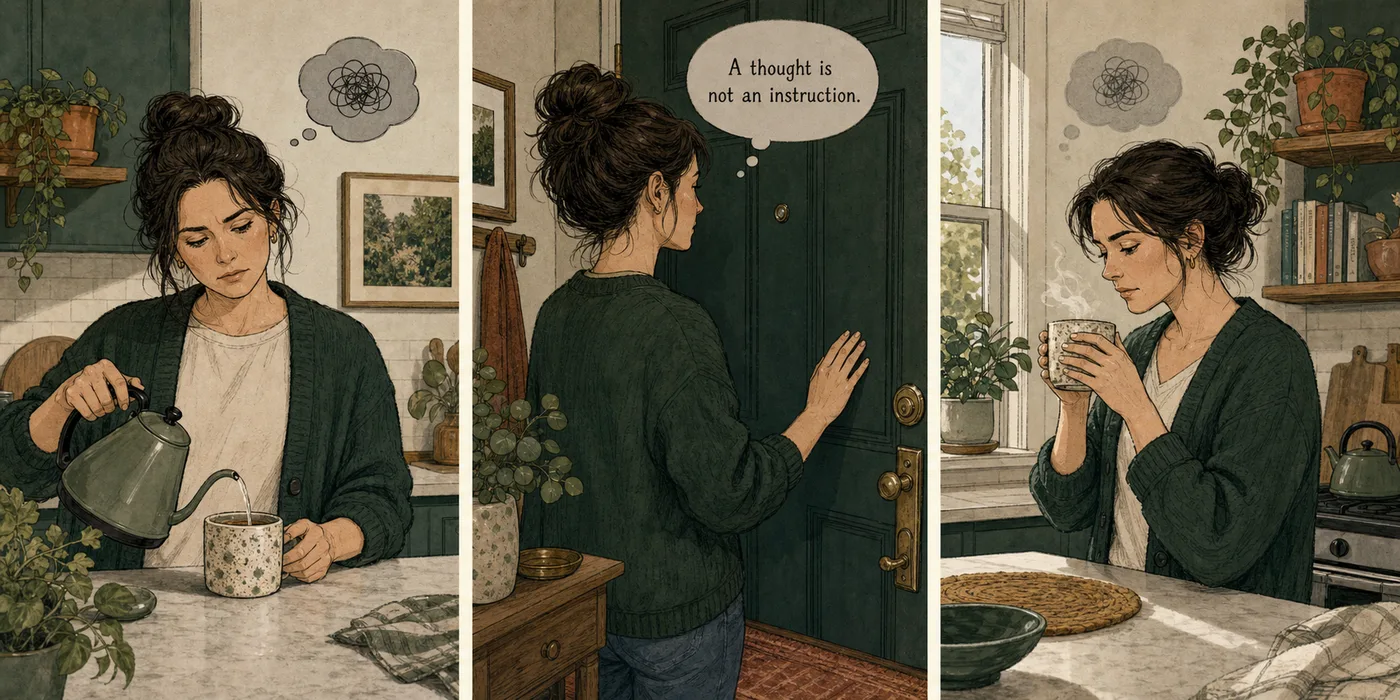
A thought is not an instruction
OCD treatment helps you notice an intrusive thought, resist the urge to neutralise it, and let the anxiety settle on its own, until the thought loses its power.

You are not your thoughts.
Tell us what’s going on and we’ll match you with a psychologist who understands OCD, usually after a free triage. No referral needed to begin.
