 The referral pathways guide



 Read with intention












 Meet the clinicians
Heat and mental health: Why hot days and nights affect your mood, and what helps

It is two in the morning in late November. The fan is pushing warm air around the room, the sheet is on the floor and you have flipped the pillow for the fourth time. By three the next afternoon you have snapped at someone you love, read the same email three times and cancelled the walk you had been looking forward to.
If that sounds familiar, you are not imagining it and you are not being weak. Heat changes how we sleep, think and feel, and over a long Australian summer those changes can add up.
This article is for anyone who notices their mood, patience, worry or concentration shift when the weather turns hot, and for people looking out for an older relative, a neighbour or someone living with a mental health condition. It covers why heat affects the mind, what research has found, who tends to feel it more, and practical ways to cope.
Key takeaways
- Hot nights matter as much as hot days. Broken sleep is one of the main ways heat reaches your mood, patience and focus.
- Research links heatwaves with poorer wellbeing and more hospital visits for mental health conditions. Much of that evidence is low certainty, and it does not show that heat causes mental illness.
- Older people, people with existing mental health conditions, outdoor workers, people who live alone or in hard-to-cool homes, and people taking certain medicines tend to be affected more.
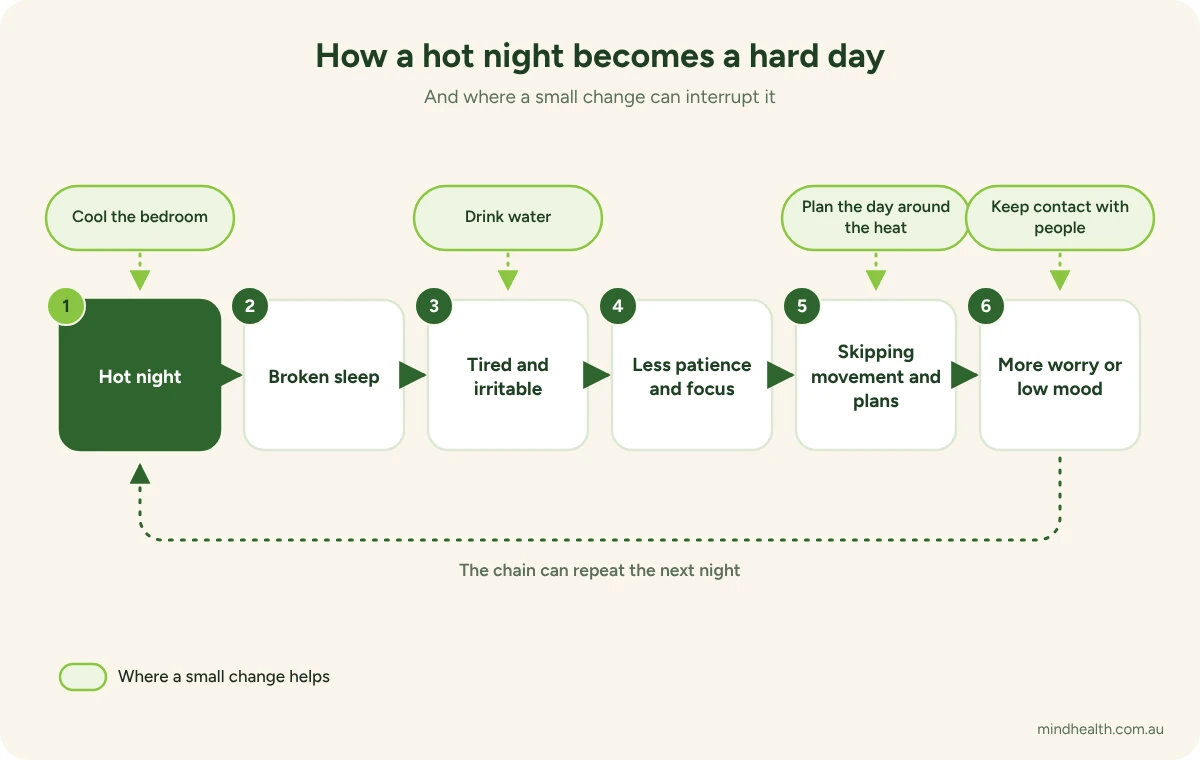
- Small, early steps help: cool the bedroom, drink water through the day, plan activity for the cooler hours and stay in touch with people.
- If low mood, worry or poor sleep lingers after the weather cools, or you have questions about your medicines and heat, talk to your GP.
Why heat gets to your mood
Feeling flat, edgy or foggy in the heat is not a character flaw. It is what a body under load feels like. Four things tend to happen at once.
Sleep takes the first hit
A heatwave is more than one scorching afternoon. It means that both the daytime maximum and the overnight minimum are unusually hot for that location over three days. Nights count because cooler nights are when the body recovers from the day’s heat.1
A study of more than seven million nights of sleep, from 47,000 adults in 68 countries, found that people fell asleep later and slept less on warmer nights, losing about 14 minutes on nights above 30 degrees. The effect was larger for older adults and for women. People living in hotter regions lost more sleep for each degree of warming, which suggests we do not simply get used to it.2
A quarter of an hour may not sound like much, but it is an average, and broken nights add up. Most of us know what follows: a shorter fuse and worries that feel louder than usual.
Dehydration creeps up
You can lose fluid through sweat faster than you notice. A review of hydration research suggests that being low on fluids may affect mood and some thinking skills, particularly in older adults and children, although the findings are not yet firm.3 Early signs of dehydration include thirst, a dry mouth, dizziness and tiredness.4
Your body is working hard to stay cool
Hot days followed by hot nights put extra stress on the body.1 Heat and anxiety can also feel alike. The signs of heat exhaustion include anxiety, headache, dizziness and muscle weakness,4 so it can be hard to tell whether you are worried, overheated or both. If in doubt, treat the heat first: get somewhere cooler, rest and drink water.
Changed behaviour, confusion or slurred speech in someone who is very hot can be a sign of heatstroke, which is a medical emergency: call triple zero (000).4
Life gets smaller
Staying inside through the hottest part of the day is the right call for your body.4 The catch is that movement, routine and time with other people help hold mood steady, and a hot spell quietly strips them away. The walk is skipped, the catch-up is cancelled and everyone is indoors together, tired and short on patience.
Put together, a hot night can roll into a tired, irritable day, cancelled plans and more worry or low mood by evening. Each link in that chain is also a place where a small change can help.
What the research has found
Three pieces of research give a sense of the picture.
- Around the world: A review of 114 studies found that hotter weather was linked with more hospital attendances and admissions for mental illness, and with poorer mental health and wellbeing in the community. When three of those studies were pooled, attendances or admissions were about 10 per cent higher during heatwaves than at other times. The reviewers rated much of the evidence as low certainty, and results varied widely between studies.5
- In western Sydney: A study of more than 4,400 mental health presentations to the Westmead Hospital emergency department from 2015 to 2019 found that presentations among women rose steadily as the daily maximum climbed from about 28 to 38 degrees. On days of around 35 degrees, the risk of a presentation was about 17 per cent higher than on a typical 24 degree day. For men, and for everyone combined, the increase was smaller and could have been due to chance. This was one hospital, so treat it as a signal, not a settled fact.6
- Across Australia: A national study estimated that high temperatures accounted for about 1.8 per cent of the health burden of mental and behavioural disorders between 2003 and 2018. Its modelling projects that this burden will grow in coming decades as the climate warms.7
These studies describe patterns across large groups of people. They do not show that heat causes mental illness, and they cannot predict how any one person will feel on a hot day.
Who tends to feel it more
Heat does not land evenly. Most people cope with the low-intensity heatwaves that are common in summer. Severe heatwaves are harder on people who are already vulnerable, and extreme heatwaves can affect anyone who does not take steps to stay cool.1
- Older people: Adults over 65 are at higher risk of heat-related illness,4 and in the sleep study above, older adults lost more sleep on warm nights.2
- People with an existing mental health condition: People living with severe mental illness are among the groups most affected by extreme heat, partly because of physical health problems that often sit alongside it.8
- People who work outdoors: Tradies, delivery riders, gardeners and farm workers cannot always choose the cool part of the day, and people who work outdoors or in hot, poorly ventilated places are at higher risk.4
- People in homes that are hard to cool: A top-floor unit or a poorly insulated rental can stay hot long after sunset. Being short of money makes it harder to insulate a home or to run air conditioning.8
- People who live alone or are isolated: Social isolation raises the risk of heat-related illness.4
- People taking certain medicines: Some medicines can affect how the body handles heat.4 That is not a reason to stop or change a medicine on your own. If you take regular medicine, ask your doctor or pharmacist what to do in hot weather.9
What helps: Practical ways to cope with the heat
The aim is to interrupt the chain early, before a hot night becomes a hard week.
Cool the bedroom and protect your sleep
- Block the sun: Shut curtains and blinds during the day, and use fans or air conditioning if you have them.4
- Air the house at night: Once the evening cools, open up and let air move through.8
- Follow the cool: Sleep in the coolest room,4 even if that means a mattress on the lounge room floor for a few nights.
- Cool your skin: A cool shower or bath helps,4 and just before bed is a good time for it.
- Go easy afterwards: Disrupted sleep can linger after the heat has passed, so allow time to rest and recover.9
Our guide on how to sleep better has more ideas.
Drink water before you are thirsty
Drink water regularly through the day, even when you do not feel thirsty, and carry a bottle when you go out. The colour of your urine is a simple guide to whether you are drinking enough. If you are already dehydrated, steer clear of alcohol, caffeinated drinks and sugary drinks.4 If you live with a long-term health condition, ask your doctor what is right for you in hot weather.9
Plan the day around the heat
The Bureau of Meteorology monitors and forecasts heatwaves,1 so check the forecast when you plan your week. Move exercise, errands and school holiday outings to the cooler ends of the day, and try not to be outdoors between 11am and 3pm. If home is too hot, spend the worst hours somewhere air-conditioned, such as a library, shopping centre, cinema or pool.4
Then swap rather than drop. A dawn walk can replace a lunchtime one, and a swim can replace a run. Keeping some movement and a loose routine going helps protect your mood.
Stay in touch and check on others
Hot weather makes it easy to cancel on people. Decide ahead of time who you will keep in touch with during a hot spell,10 and shift catch-ups to a cooler hour, a cooler place or a phone call. If you have an older relative, friend or neighbour, visit or call at least once a day in hot weather and check they are drinking water.4 Keep checking in after the heat has passed.9
Take notice of your own energy, mood and ability to think and plan too. If these start to slip in the heat, treat it as a cue to cool down and reach out for support.10
What psychological support involves
A psychologist cannot change the weather. But if summer reliably brings poor sleep, a short temper, rising worry or a flat mood, it can help to look at the pattern with someone.
At Mind Health, our psychologists work with people on sleep difficulties, anxiety, low mood and depression, and stress. Support usually starts with an assessment of what is happening for you: how you are sleeping, what has changed, and whether heat is the whole story or is adding to something that was already there.
From there, sessions might include:
- Sleep strategies: Building routines that support sleep, and working with the worry that keeps you awake.
- Skills for worry and irritability: Approaches such as cognitive behavioural therapy (CBT) look at how thoughts, body sensations and actions feed one another.
- Keeping life going: Planning movement, activity and social contact that fit around hot weather, so your world does not shrink over summer.
- A plan for hot spells: Working out your early warning signs and what you will do when a heatwave is forecast.
Sessions can be in person or by telehealth, which can be handy when travelling in the heat is hard.
When to see your GP or a psychologist
A few rough days during a heatwave are common and often ease when the weather does. It is worth talking to someone when:
- It lingers: Low mood, worry, irritability or poor sleep carries on after the weather has cooled, or gets in the way of work or relationships.
- Heat makes an existing condition harder: A mental health condition becomes more difficult to manage in hot weather.
- You have questions about medicines: You take regular medicine or have a long-term health condition and are unsure what to do in the heat.9
- You feel physically unwell: See a doctor if you feel unwell during or after a heatwave.4
Your GP is a good first step. They can check your physical health and talk with you about whether a Mental Health Treatment Plan (MHTP) and a referral to a psychologist would suit you. If you feel unsafe, or your distress is getting worse quickly, please seek help promptly from your GP or a health service.
Frequently asked questions
Why do I feel more irritable and anxious in hot weather?
Hot nights break up sleep, your body works harder to stay cool, you lose fluid through sweat, and exercise and social plans often fall away. Each of these can wear down patience and focus, and together they add up. Some signs of heat exhaustion, such as anxiety, headache and dizziness, can also feel a lot like worry.
Can hot weather cause mental illness?
Research links heatwaves with poorer wellbeing and more hospital visits for mental health conditions, but it does not show that heat causes mental illness. These are patterns across large groups of people, and much of the evidence is rated as low certainty. It is more useful to think of heat as an extra load, especially when you are already under strain.
How can I sleep better on hot nights?
Keep curtains and blinds closed during the day, air the house once the evening cools, and use a fan or air conditioning if you have one. Sleep in the coolest room, have a cool shower before bed and drink water through the day. Expect sleep to take a few days to settle after the heat has passed.
Should I stop taking my medicine during a heatwave?
No. Do not stop or change a medicine on your own. Some medicines can affect how the body handles heat, so if you take regular medicine, ask your doctor what to do in hot weather, ideally before summer starts. Your pharmacist can answer questions too. Any change to a medicine is a decision to make with your doctor.
When should I see a GP or psychologist about how heat affects me?
See your GP if low mood, worry, irritability or poor sleep carries on after the weather cools, if heat makes an existing condition harder to manage, or if you feel physically unwell during or after a heatwave. Your GP can check your health and talk with you about whether seeing a psychologist would help.
References
- Bureau of Meteorology. (2021). What is a heatwave? Heatwave knowledge centre. Last modified 22 September 2026. https://www.bom.gov.au/resources/learn-and-explore/heatwave-knowledge-centre/what-is-a-heatwave
- Minor, K., Bjerre-Nielsen, A., Jonasdottir, S. S., Lehmann, S., & Obradovich, N. (2022). Rising temperatures erode human sleep globally. One Earth, 5(5), 534-549. https://doi.org/10.1016/j.oneear.2022.04.008
- Masento, N. A., Golightly, M., Field, D. T., Butler, L. T., & van Reekum, C. M. (2014). Effects of hydration status on cognitive performance and mood. British Journal of Nutrition, 111(10), 1841-1852. https://doi.org/10.1017/S0007114513004455
- Healthdirect Australia. (2024). Hot weather risks and staying cool. Last reviewed December 2024. https://www.healthdirect.gov.au/hot-weather-risks-and-staying-cool
- Thompson, R., Lawrance, E. L., Roberts, L. F., Grailey, K., Ashrafian, H., Maheswaran, H., Toledano, M. B., & Darzi, A. (2023). Ambient temperature and mental health: A systematic review and meta-analysis. The Lancet Planetary Health, 7(7), e580-e589. https://doi.org/10.1016/S2542-5196(23)00104-3
- Ooi, W. Y. C., Braund, T. A., Elhindi, J., & Harris, A. W. F. (2024). Ambient maximum daily temperature and mental health-related presentations to a western Sydney emergency department, 2015-2019: Analysis of hospital and meteorological data. Medical Journal of Australia, 220(7), 379-380. https://doi.org/10.5694/mja2.52267
- Liu, J., Varghese, B. M., Hansen, A., Dear, K., Morgan, G., Driscoll, T., Zhang, Y., Prescott, V., Dolar, V., Gourley, M., Capon, A., & Bi, P. (2025). Increasing burden of poor mental health attributable to high temperature in Australia. Nature Climate Change, 15(5), 489-496. https://doi.org/10.1038/s41558-025-02309-x
- Harris, A., Barton, M., Waniganayake, L., Eapen, V., & Hamrosi, M. (2025). Heat and mental health. Australian Journal of General Practice, 54(1-2), 62-65. https://doi.org/10.31128/AJGP-07-24-7336
- NSW Health. (2024). Plan ahead to beat the heat. Hot weather and heatwaves (Beat the Heat). Current as at 18 December 2024. https://www.health.nsw.gov.au/environment/beattheheat/Pages/prepare-for-heat.aspx
- Australian Red Cross. (n.d.). Extreme heat safety: How to prepare for heatwaves. Retrieved 10 November 2026. https://www.redcross.org.au/extremeheat/
Related reading
- Sleep disorders and mental health: The vicious cycle and how to break it
- Managing holiday stress: A practical guide for the festive season
- How to actually help someone who’s struggling: A psychologist’s guide
This article is general information only and is not a substitute for personal advice from a qualified health professional. If you are concerned about your mental health, please speak with your GP or a psychologist.
Free · 5 to 10 minHow are you going, really?Take the Mind Health Check: a few short questions, then a private report.
More on wellbeing & self.
 Wellbeing & Self
Chronic pain and mental health: How psychology helps with persistent pain
How persistent pain, stress, sleep and mood affect each other, what pain psychology involves, and how to get…
Mind Health team12 min Wellbeing & Self
Men’s mental health: how to start the conversation with your GP
A practical guide for men who haven't felt like themselves: what to say to your GP, what can…
Mind Health team4 min Wellbeing & Self
AI companions: When a chatbot becomes your 2am confidant
Why people confide in AI chatbots at 2am, what the research and Australia's new rules say, and how…
 Bülent Ada12 min

Your next step starts here.
Tell us what's going on and we'll match you with the right psychologist, usually after a free triage. No referral needed to begin.
