 The referral pathways guide

 Read with intention












 Meet the clinicians
HSC exam stress: A guide for students and parents in NSW

If you are in Year 12 in New South Wales, August can feel crowded. Trial exams may be under way or just finished, marks are coming back, and the written HSC exams begin on Tuesday 13 October 2026 with English Paper 1.3 The 2026 written exams ran from 13 October to 5 November.3 The weeks before them are enough time to prepare well, and enough time for worry to build.
This guide is for students and for the parents and carers living alongside them. Some sections speak to students and some to parents; it helps to read both. It covers ordinary pressure versus anxiety, sleep and study rhythm, perfectionism and catastrophising, what parents can say and do, freezing or panicking in an exam, and when to get help.
Key takeaways
- Some nerves before the HSC are normal, but worry that crowds out sleep, study, eating or friends needs attention.
- Protecting sleep and studying in short, planned sessions tends to help more than late nights.
- Perfectionism and catastrophising make exams feel more dangerous than they are, and both can be noticed and questioned.
- Parents help most by listening and supporting routines, while warnings about what happens if marks are low can backfire.
- If anxiety is affecting daily life, get help now rather than after the exams.
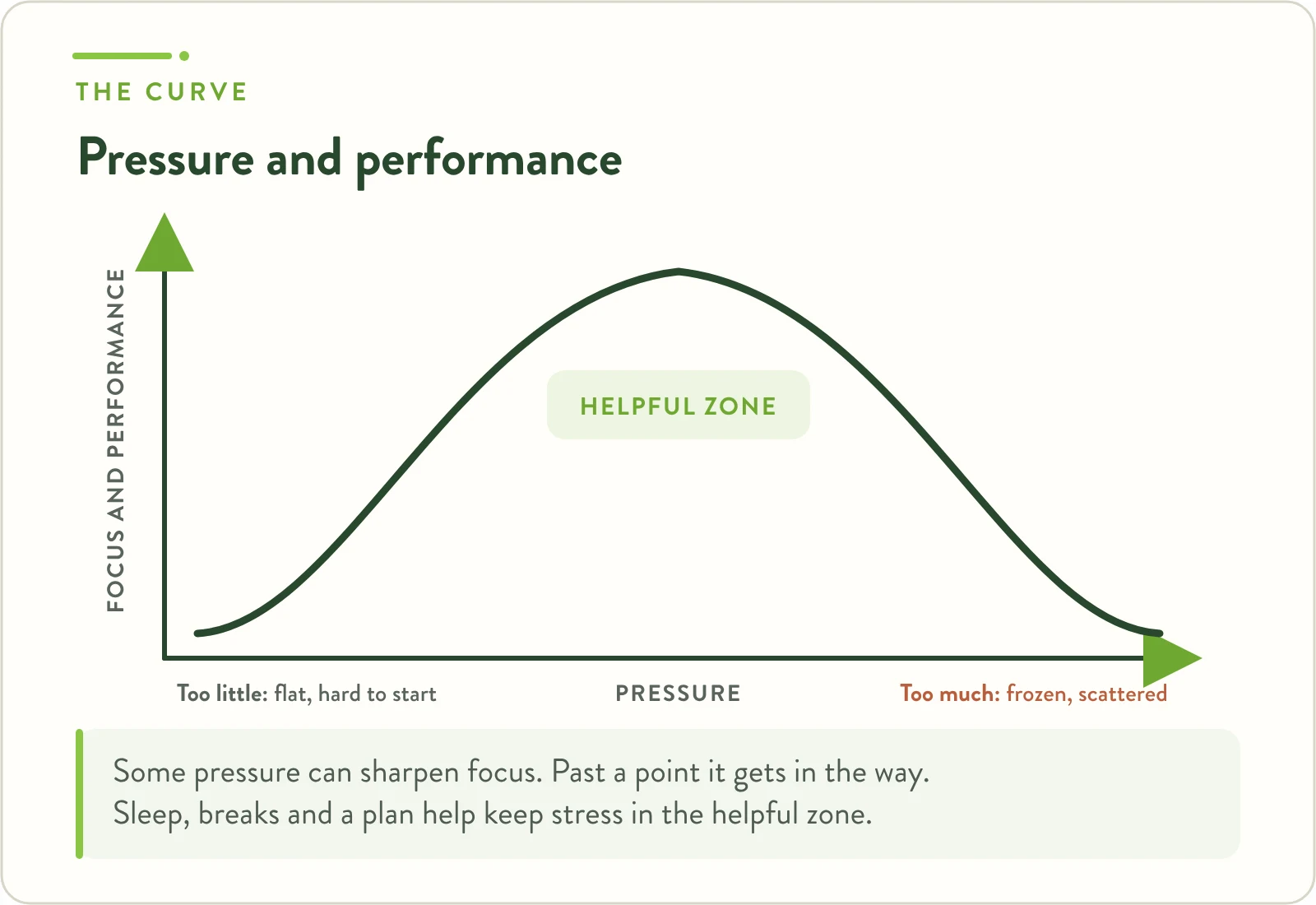
Normal exam pressure or anxiety that is getting in the way?
Feeling nervous about the HSC is a sensible response to something that matters. Kids Helpline notes that exam pressure can help you focus but can also tip over into stress,2 and Raising Children Network notes that too much stress can interfere with sleep, thinking and learning.6
Anxiety is a little different: worry or dread that something bad will happen, or that you will not cope, which can show up even without a challenging event.6
A 2018 review that pooled 238 studies found that higher test anxiety was linked with lower results on standardised tests, university entrance exams and school grades, with effects in the small to moderate range.8 Self-esteem was a strong predictor of test anxiety, and exams seen as difficult or high stakes were linked with more of it.8 More anxiety is not the same as more motivation.
Signs that stress may have become more than ordinary pressure include:
- trouble getting to sleep or staying asleep most nights
- headaches or stomach aches before school or exams
- avoiding study, classes or trials
- pulling back from friends, family and things they usually enjoy
- feeling irritable or overwhelmed much of the time
- sudden surges of fear with a racing heart or trouble breathing
One or two of these in a hard week is common. When several keep going, or they stop a student doing ordinary things, it is worth talking to someone. If school itself is becoming hard to face, see our guide to school refusal and anxiety.
For students: sleep and a study rhythm you can keep
Sleep is part of studying
When time feels short, sleep is usually the first thing to go. Kids Helpline is direct: don’t skip sleep to study, because sleep is when the brain consolidates learning into longer-term memory.2
Raising Children Network says most teenagers need 8 to 10 hours a night.7 Early nights can feel impossible because in adolescence melatonin, the hormone that helps you feel sleepy, is released later at night than in childhood.7 A few things help:
- Keep wake-up times on school days and weekends within an hour or two of each other.7
- Put devices away for the hour before bed, and charge them outside your bedroom.7
- Cut back on energy drinks, coffee, tea and cola from the late afternoon.7
If sleep has been poor for a while, our page on sleep and insomnia explains what else can help.
A rhythm, not a marathon
Long, unbroken study days are hard to sustain. Kids Helpline suggests setting a clear goal for each session, breaking it into small tasks, and studying in shorter bursts, because people tend to remember most from the first and last 15 minutes.2 It also suggests active methods, like explaining a topic to a friend or drawing diagrams, over rereading and highlighting.2
Build rest in on purpose. Raising Children Network lists exercise and time for fun among the habits that help teenagers manage stress.6
For students: perfectionism and catastrophising
Perfectionism
High standards are fine. Perfectionism is when anything short of the top mark feels like failure and your sense of worth rises and falls with each result. It can look like endlessly rewriting notes, avoiding practice questions in case they go badly, or studying past midnight because stopping feels unsafe.
Try “good enough” targets for each session, such as three practice questions done and marked, and notice when you are polishing rather than learning. Our article on perfectionism and high standards goes further.
Catastrophising
Catastrophising is when the mind jumps from a small setback to the worst outcome: “I blanked on that trial question, so I’ll bomb the HSC, so my future is ruined.” Each step feels convincing, but it is a chain of guesses. When you notice it, write the thought down and ask:
- What actually happened, and what am I predicting?
- What would I say to a friend who thought this?
- If the thing I fear did happen, what would I do next?
As Kids Helpline puts it, if you don’t do as well as you hope, there are many different ways to reach your future study and work goals.2 If worry is taking up hours of your day, our page on worry has more ideas.
For parents: what helps, and what to avoid
The most useful things parents can do are fairly ordinary.
- Notice it and say so. Let your teenager know you can see they are stressed and you are there to help. Raising Children Network notes that warmth can help young people be kinder to themselves.6
- Listen first. Ask open questions, such as “What would make this week a bit easier?”, and resist jumping to solutions.
- Plan together. If they are very worried, work out a study timetable with them, not for them.6
- Look after the basics. Regular meals, a calm routine and devices out of bedrooms overnight.
- Model it. Teenagers learn a lot from watching how you handle your own stress.6
It is tempting to motivate with warnings about what is at stake. A study of 347 Year 11 students in England looked at teachers’ warnings about failing an upcoming maths exam.5 When students heard these often and found them threatening, this was linked with less self-driven motivation and lower exam scores.5 It studied teachers, not parents, but it is a useful caution at home. Things worth avoiding:
- warnings like “If you don’t get the marks, you’ll have no options”
- comparisons with siblings or friends, and running commentary on ATAR predictions
- detailed post-mortems straight after each exam
- “Just relax” or “Don’t stress”, which can leave a teenager feeling unheard
After an exam, try asking how they are rather than how it went. Our information for families has more on supporting a young person.
If you freeze or panic in an exam
Going blank in an exam is frightening, but it is a stress response, not a sign that what you studied has gone. It helps to have a short plan you have practised:
- Pause. Put your pen down for a moment.
- Slow your breathing. Kids Helpline suggests slowing your breathing.2 Try breathing out a little longer than you breathe in.
- Ground yourself. Feel your feet on the floor and notice a few things you can see.
- Move to something you can do. Kids Helpline points out that you don’t have to answer in order, so go to an easier question and come back later.2
- Write something. A heading, a formula or a quick plan can get your thinking moving again.
Practise these steps in trials and timed questions at home so they feel familiar by October.
Sometimes the feeling is stronger: a pounding heart, shaking, a tight chest or a sense of doom. That may be a panic attack. It is intense and frightening, but it passes. Our guide to understanding panic attacks explains what is happening. If they keep happening, see a GP.
If you feel unwell before an HSC exam, NESA says to tell the presiding officer when you arrive, or straight away if it happens during the exam.4 Its illness and misadventure process has strict rules, including independent evidence on the same day, so ask your school how it works now.4
When to get help
You do not need to wait until the exams are over, or until things are very bad.
- School counsellor or wellbeing team. Often the easiest place to start.
- A GP. A GP can check physical health and, if appropriate, prepare a Mental Health Treatment Plan (often called a mental health care plan) for Medicare-rebated psychology sessions. The plan generally needs to come from the practice where the person is enrolled in MyMedicare, or their usual GP.1
- headspace. Supports young people aged 12 to 25 through local centres, and online and phone support through eheadspace on 1800 650 890. See headspace.org.au.
- Kids Helpline. Free, private and confidential phone and online counselling for young people aged 5 to 25, 24 hours a day: 1800 55 1800 or kidshelpline.com.au.
- A psychologist. Can work with a young person on exam anxiety, panic, perfectionism, sleep and low mood.
If a young person talks about not wanting to be alive, or about hurting themselves, treat it as urgent and get help the same day. Our urgent help page lists who to contact.
At Mind Health we see young people and families in Parramatta and by telehealth, and you can read about our approach to anxiety treatment.
Frequently asked questions
Is it normal to feel anxious about the HSC?
Yes. Some nerves before a high-stakes exam are expected and can help you focus. It becomes a concern when worry is constant, disrupts sleep or eating, or stops you studying, going to school or seeing friends. If that is happening, talk to a school counsellor, a GP or an adult you trust.
What should parents avoid saying before the HSC?
Try to avoid warnings about what happens if marks are low, comparisons with siblings or friends, and constant talk about ATAR predictions. A study of teachers’ warnings about failing an exam linked them with lower motivation and scores when students found them threatening. Calm interest, listening and help with routines are more useful.
What can I do if my mind goes blank in an exam?
Pause and put your pen down, then slow your breathing, letting each breath out be a little longer than the breath in. Feel your feet on the floor. Move to a question you find easier and come back later. Writing a plan or a formula can get your thinking moving again.
When should a student see a professional about exam stress?
If anxiety is affecting sleep, eating, school attendance or friendships, if panic attacks are happening, or if low mood or hopelessness is setting in, it is time to get help. A school counsellor or GP is a sensible first step, and headspace and Kids Helpline also help young people.
References
- Australian Government Department of Health, Disability and Ageing (2025). Fact sheet for patients: Better Access to Psychiatrists, Psychologists and General Practitioners through the MBS initiative. health.gov.au. https://www.health.gov.au/sites/default/files/2025-10/better-access-fact-sheet-patients_0.pdf
- Kids Helpline (2023). Exam stress. yourtown. https://kidshelpline.com.au/teens/issues/exam-stress
- NSW Education Standards Authority (2026). 2026 HSC timetables released. NSW Government. https://www.nsw.gov.au/education-and-training/nesa/news/all/2026-hsc-timetables-released
- NSW Education Standards Authority (2026). Rules and Procedures guide 2026: 5. Term 4. NSW Government. https://www.nsw.gov.au/education-and-training/nesa/hsc/rules-and-procedures/2026-guide/term-4
- Putwain, D., & Remedios, R. (2014). The scare tactic: Do fear appeals predict motivation and exam scores? School Psychology Quarterly, 29(4), 503–516. https://doi.org/10.1037/spq0000048
- Raising Children Network (2024). Stress and stress management: pre-teens and teenagers. raisingchildren.net.au. https://raisingchildren.net.au/pre-teens/mental-health-physical-health/stress-anxiety-depression/stress-in-teens
- Raising Children Network (2026). Teenage sleep: recommendations, problems, tips and FAQs. raisingchildren.net.au. https://raisingchildren.net.au/teens/healthy-lifestyle/sleep/sleep-teens
- von der Embse, N., Jester, D., Roy, D., & Post, J. (2018). Test anxiety effects, predictors, and correlates: A 30-year meta-analytic review. Journal of Affective Disorders, 227, 483–493. https://doi.org/10.1016/j.jad.2017.11.048
Related reading
This article is general information only and is not a substitute for personal advice from a qualified health professional. If you are concerned about your mental health, please speak with your GP or a psychologist.
Get professional support
Talk to a psychologist at Mind Health
If you’re struggling with your mental health, our psychologists are here to help.
Medicare rebates available with a Mental Health Treatment Plan · Telehealth appointments Australia-wide
Helpful Australian Resources
- Beyond Blue: Support for depression, anxiety and related conditions. Call 1300 22 4636.
- Lifeline Australia: Crisis support and suicide prevention. Call 13 11 14 (24/7).
- Medicare Mental Health: Australian Government mental health gateway. Call 1800 595 212.
- Black Dog Institute: Research-based resources on depression, bipolar disorder, and PTSD.
- SANE Australia: Support for people living with complex mental illness. Call 1800 187 263.
More on anxiety & stress.
 Anxiety & Stress
Generalised anxiety disorder (GAD): When worry won’t switch off
What generalised anxiety disorder is, how it differs from everyday worry, panic and depression, and what assessment, CBT…
 Bülent Ada12 min
 Anxiety & Stress
Doomscrolling: Why bad news is so hard to put down, and how to step back
Why bad news is so hard to stop scrolling, what research links news overload to (stress, low mood,…
Mind Health team12 min Anxiety & Stress
Money worries and mental health: Coping with cost-of-living stress
How cost-of-living stress affects mood, sleep, relationships and thinking, with practical psychological steps and where to find free…
Mind Health team10 min
Your next step starts here.
Tell us what's going on and we'll match you with the right psychologist, usually after a free triage. No referral needed to begin.
