 The referral pathways guide



 Read with intention












 Meet the clinicians
Money worries and mental health: Coping with cost-of-living stress

If you have been lying awake doing sums, dreading the next bill or feeling your stomach drop when your banking app loads, you are not alone, and it is not a sign of weakness. Money worry is one of the most common pressures on mental health in Australia.
This article is for anyone feeling the squeeze of the cost of living, whether you are behind on payments or anxious about keeping up. It is not financial advice. It explains how financial stress affects the mind, offers practical psychological steps, and shows where to get free help with both the money and the stress.
Key takeaways
- Financial stress is closely linked with psychological distress in Australia, and the link runs in both directions.
- Money worry can show up as low mood, poor sleep, tension with loved ones and difficulty thinking clearly.
- Shame and avoidance are understandable, but they tend to let both money problems and anxiety grow.
- Sorting what you can and cannot control, then tackling one problem at a time, can make things feel less overwhelming.
- Free financial counselling through the National Debt Helpline (1800 007 007) can sit alongside support from a GP or psychologist.
How common it is
Cost-of-living pressure is widespread. In the ABS General Social Survey, a quarter of households (25%) reported at least one cash flow problem in 2025, up from 21% in 2020.1
Using HILDA survey data, the Australian Institute of Health and Welfare (AIHW) reported that in 2023 nearly 55% of financially stressed people had high or very high psychological distress, about 2.6 times the rate among people not under financial stress.2 Here, financial stress means two or more signs of a cash shortage, such as not paying a utility bill or the rent on time, or going without meals.2
The relationship works both ways. The AIHW found 27% of people with poor mental health or high distress reported financial stress, compared with 8 to 9% of people with good mental health or low to moderate distress.2 As Beyond Blue notes, mental health challenges can make managing money harder.4
International research agrees. A 2013 systematic review of 65 papers, which included a meta-analysis, found people with personal unsecured debt (debt not tied to an asset such as a house) had about three times the odds of a mental health condition, with more severe debt generally linked with worse health.8 The authors noted that cause and effect is hard to establish.8
How financial stress affects mood, sleep, relationships and thinking
When money worry does not go away, the body’s stress response stays switched on. It tends to show up in four places.
Mood
Beyond Blue notes that money stress can increase anxiety, depression and social withdrawal.4 You might feel on edge, flat or hopeless, or notice guilt about past decisions. Some people drink more or reach for other quick fixes, which usually adds to the problem.
Sleep
Money worry often gets loudest at night, when there is nothing you can do about it. Lying awake running numbers keeps the mind alert, and a poor night makes the next day’s problems feel bigger. If this pattern has settled in, see our page on sleep and insomnia.
Relationships
In a community poll commissioned by Beyond Blue and released in June 2026, financial pressure was the biggest external stressor on mental health for 47% of respondents, and on relationships for 43%.3 Beyond Blue noted that money pressure can leave people more on edge, reactive or withdrawn.3
Thinking
Beyond Blue also points out that financial stress can change how we make decisions, and that when emotions run high, our ability to reason can drop.3 This can look like forgetting due dates, snap decisions made just to get relief, or freezing. It is not a character flaw, and it is why the steps below are deliberately small.
Shame and avoidance: why the envelope stays unopened
Many people feel ashamed about money, even when the cause is rising prices, a job loss, illness or a relationship ending. Shame pushes us to hide. Beyond Blue lists withdrawing from others, keeping problems from those closest to us and from health professionals, and delaying acknowledging a problem among the signs that money is affecting wellbeing.4
Not opening the letter brings brief relief, but the problem keeps growing in the background, and so does the fear of looking at it. Over time, avoidance tends to keep anxiety going. A few ways to ease back in:
- Start smaller than feels useful. Open one envelope, or log in and simply look, without fixing anything today.
- Set a short, regular money time. Beyond Blue suggests making regular time for money matters a habit.4 Twenty minutes a week is easier to face than an open-ended reckoning.
- Talk to yourself as you would to a friend. “This is hard, and I am dealing with it” helps more than replaying past mistakes.
- Tell one person who will listen without judgement.4
Sorting what you can and cannot control
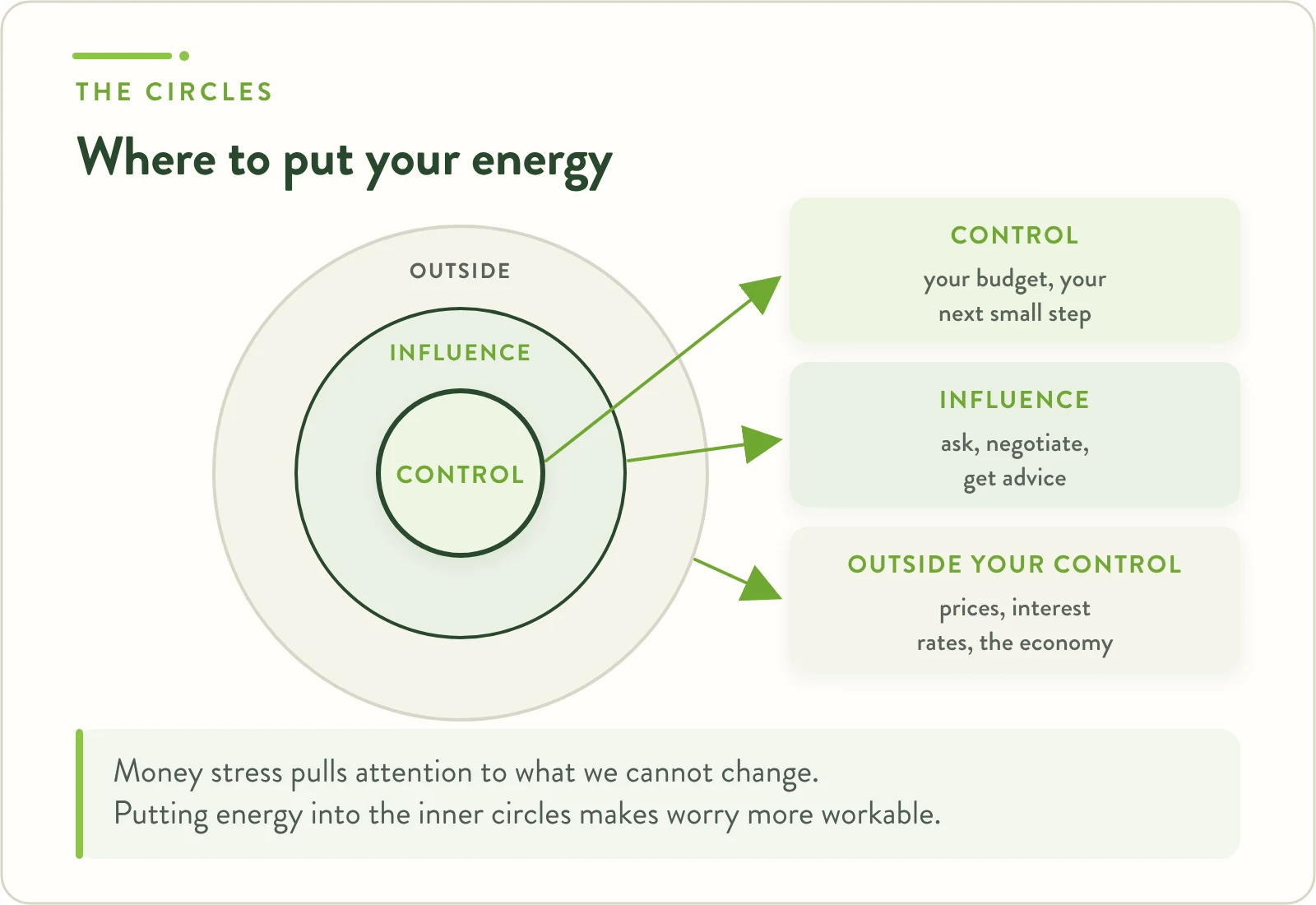
When everything feels urgent, try sorting your worries into two columns.
- Outside your control: interest rates, rent rises, grocery prices, decisions your employer makes.
- Within your control, at least in part: which bill you look at first, whether you ask for a payment arrangement, who you call for advice, and how you look after your sleep and health.
It is fair to feel angry about the first column, but worry spent there rarely changes anything. Put your effort into the second. Our article on stress relief techniques has ideas for calming your body when the worry will not switch off.
A simple problem-solving routine
Problem-solving therapy teaches a structured way to tackle practical difficulties. A 2018 meta-analysis of 30 randomised trials concluded it is probably an effective treatment for depression, with small effects in the most rigorous trials, comparable to other psychological treatments.5 That research was about depression rather than money, but the steps are a practical fit:
- Name one problem clearly. “The electricity bill is two months overdue” is easier to work with than “everything is a mess”.
- List every option without judging them yet: ringing the provider, asking about a hardship arrangement, calling a financial counsellor, checking concessions.
- Weigh up the pros and cons of the two or three most realistic options.
- Choose one and find a first step small enough to do in the next few days, such as finding the account number.
- Do it, then review. If it did not work, go back to your list. That is part of the process, not failure.
Talking about money with a partner
Money pressure often lands on relationships. In its June 2026 release, Beyond Blue suggested ways to protect a relationship during financial strain, including:3
- Name the stress, so it does not come out as irritation or distance.
- Calm down before problem solving. It is fine to take a break and come back to the conversation.
- Get on the same page about what is causing the stress, what is within your control and what needs attention first.
- Put the relationship ahead of the problem. Small kindnesses still count when the numbers have not changed.
Pick a time when neither of you is tired or rushed, start with how you feel rather than what the other person did, and agree on one next step. If money arguments keep going in circles, couples therapy offers a structured space to work through them.
Money conflict is different from financial abuse. If a partner controls all the money, stops you working or pressures you into debt, the National Debt Helpline’s page on financial abuse explains the signs. Your safety comes first.
Getting help with the money itself
A financial counsellor is a good first call. Financial Counselling Australia offers free, confidential and independent financial counselling through the National Debt Helpline on 1800 007 007. Its website lists phone hours of 9:30am to 4:30pm weekdays, and live chat from 9am to 8pm weekdays.7 Financial counselling is not means-tested, and counsellors do not lend money or sell products.7 They can:
- look at your whole situation, including income, spending and debts
- work out which debts are priorities and build a workable budget
- explain your rights and options
- negotiate with creditors on your behalf7
Aboriginal and Torres Strait Islander people can also call Mob Strong Debt Help on 1800 808 488, a free legal advice and financial counselling service from Financial Rights Legal Centre. To start on your own, ASIC’s Moneysmart website has a free budget planner.
When to get help for your mental health
Money stress is a normal response to a hard situation, but it can tip into something that needs more support. Consider talking to your GP or a psychologist if:
- worry, low mood or hopelessness has been there most days for several weeks
- you are struggling to sleep, eat, work or look after yourself
- you are drinking, gambling or using other substances to cope
- arguments at home are escalating, or you feel unsafe
Your GP can, where appropriate, prepare a Mental Health Treatment Plan (often called a mental health care plan), which gives access to Medicare rebates for sessions with a psychologist. Since 1 November 2025, Medicare generally pays for these sessions only when the plan is prepared at the practice where you are registered under MyMedicare, or by your usual GP.6 Our guide on getting a mental health care plan walks through the steps.
A psychologist can help with the anxiety, low mood and relationship strain that money problems can bring, using approaches such as cognitive behavioural therapy and structured problem-solving. At Mind Health we see people in Parramatta and by telehealth across Australia for stress and anxiety.
If you feel unsafe or are having thoughts of ending your life, please get support now through our urgent help page.
Frequently asked questions
Can money worries cause anxiety or depression?
Financial stress is strongly linked with anxiety, depression and psychological distress, and Australian data show financially stressed people report much higher distress. Research cannot always show which comes first, and the link runs both ways. If worry or low mood is affecting your daily life, it is worth talking to your GP.
Is the National Debt Helpline free?
Yes. The National Debt Helpline (1800 007 007) offers free, confidential and independent financial counselling, and it is not means-tested. Financial counsellors do not lend money or sell products. They can help you prioritise debts, build a budget and negotiate with the people you owe.
Can a psychologist help if the real problem is money?
A psychologist cannot pay your bills, but they can help with what the stress is doing to you: the anxiety, low mood, sleep problems, avoidance and conflict. Seeing a financial counsellor and a psychologist at the same time is a reasonable approach.
I am worried about the cost of therapy. What can I do?
Ask your GP about a Mental Health Treatment Plan, which gives access to Medicare rebates for sessions with a psychologist. Ask any practice about its fees and out-of-pocket costs before you book. If the cost of living is part of the worry, free financial counselling through the National Debt Helpline can help too.
References
- Australian Bureau of Statistics (2026). General Social Survey: Summary Results, Australia, 2025. ABS. https://www.abs.gov.au/statistics/people/people-and-communities/general-social-survey-summary-results-australia/2025
- Australian Institute of Health and Welfare (2025). Financial stress and mental health. AIHW. https://www.aihw.gov.au/mental-health/topic-areas/other-mental-health-reports/financial-stress
- Beyond Blue (2026). Beyond Blue data reveals financial pressures having negative impact on our relationships. Beyond Blue media release, 1 June 2026. https://www.beyondblue.org.au/about/media/media-releases/beyond-blue-data-reveals-financial-pressures-having-negative-impact-on-our-relationships
- Beyond Blue (n.d.). Financial wellbeing, money & mental health. Beyond Blue. https://www.beyondblue.org.au/mental-health/financial-wellbeing
- Cuijpers, P., de Wit, L., Kleiboer, A., Karyotaki, E., & Ebert, D. D. (2018). Problem-solving therapy for adult depression: An updated meta-analysis. European Psychiatry, 48, 27–37. https://doi.org/10.1016/j.eurpsy.2017.11.006
- Department of Health, Disability and Ageing (2025). Better Access redesign from 1 November 2025. Australian Government. https://www.health.gov.au/sites/default/files/2025-10/better-access-redesign-from-1-november-2025_0.pdf
- Financial Counselling Australia (n.d.). What is financial counselling? National Debt Helpline. https://ndh.org.au/financial-counselling/what-is-financial-counselling/
- Richardson, T., Elliott, P., & Roberts, R. (2013). The relationship between personal unsecured debt and mental and physical health: A systematic review and meta-analysis. Clinical Psychology Review, 33(8), 1148–1162. https://doi.org/10.1016/j.cpr.2013.08.009
Related reading
This article is general information only and is not a substitute for personal advice from a qualified health professional. If you are concerned about your mental health, please speak with your GP or a psychologist.
Get professional support
Talk to a psychologist at Mind Health
If you’re struggling with your mental health, our psychologists are here to help.
Medicare rebates available with a Mental Health Treatment Plan · Telehealth appointments Australia-wide
Helpful Australian Resources
- Beyond Blue: Support for depression, anxiety and related conditions. Call 1300 22 4636.
- Lifeline Australia: Crisis support and suicide prevention. Call 13 11 14 (24/7).
- Medicare Mental Health: Australian Government mental health gateway. Call 1800 595 212.
- Black Dog Institute: Research-based resources on depression, bipolar disorder, and PTSD.
- SANE Australia: Support for people living with complex mental illness. Call 1800 187 263.
More on anxiety & stress.
 Anxiety & Stress
Generalised anxiety disorder (GAD): When worry won’t switch off
What generalised anxiety disorder is, how it differs from everyday worry, panic and depression, and what assessment, CBT…
 Bülent Ada12 min
 Anxiety & Stress
Doomscrolling: Why bad news is so hard to put down, and how to step back
Why bad news is so hard to stop scrolling, what research links news overload to (stress, low mood,…
Mind Health team12 min Anxiety & Stress
HSC exam stress: A guide for students and parents in NSW
Practical help for NSW Year 12 students and their parents: sleep, study rhythm, perfectionism, freezing in exams, what…
Mind Health team10 min
Your next step starts here.
Tell us what's going on and we'll match you with the right psychologist, usually after a free triage. No referral needed to begin.
