 The referral pathways guide



 Read with intention












 Meet the clinicians
Generalised anxiety disorder (GAD): When worry won’t switch off

Everyone worries. A bill is due, a child is unwell, a deadline is close, and your mind runs through what could go wrong. For most people the worry settles once the problem passes.
For some adults it does not settle. The worry moves from one topic to the next, feels hard to control and comes with a tense, tired body. When that pattern lasts for months and gets in the way of work, sleep or relationships, it may be generalised anxiety disorder, often shortened to GAD.
This article is for Australian adults who suspect their worry has gone beyond the everyday kind, and for the people who care about them. It covers what GAD is, how it differs from ordinary worry and from other conditions, what assessment and psychological support involve, where your GP fits in, and which self-help steps have research behind them.
Key takeaways
- GAD is persistent, hard to control worry about many everyday things, present on most days for 6 months or more, that affects daily life.
- A national survey found that 3.8% of Australians aged 16 to 85 had GAD in the previous 12 months.
- What separates GAD from ordinary worry is the pattern: how often it happens, how widely it spreads and how hard it is to stop.
- Australian and New Zealand clinical guidelines list cognitive behavioural therapy (CBT), face to face or as a guided online program, as an initial treatment option for GAD.
- Your GP is a sound first step. They can check for medical conditions that need ruling out and, if you are eligible, prepare a Mental Health Treatment Plan.
What is generalised anxiety disorder?
Generalised anxiety disorder is a type of anxiety disorder in which worry is persistent and affects day to day life.1 The worry is there most of the time and across many different situations, often over fairly minor things, and it can wear down sleep and energy.1
People with GAD often notice several of the following.1
- Worry about many different things that feels uncontrollable.
- Worry that makes everyday things, such as working or seeing friends, harder to do.
- Feeling tired a lot of the time but not sleeping properly.
- Tension in the body, such as a sore jaw or back.
- A racing heart or a dry mouth.
- Trouble concentrating, irritability or restlessness.
In everyday life this can look like lying awake running through tomorrow’s meeting, then the car registration, then whether a parent’s cough is something serious, and getting up already tired.
How common is GAD in Australia?
Anxiety disorders are the most common group of mental disorders in Australia.2 A national survey run from 2020 to 2022 found that 17.2% of people aged 16 to 85, about 3.4 million Australians, had an anxiety disorder in the previous 12 months.2 For GAD specifically the figure was 3.8%: 4.8% of females and 2.8% of males.2
GAD tends to first appear relatively late, on average in the early thirties, and most people who develop it have been nervous or anxious for a long time before that.3
When does everyday worry become GAD?
Worry itself is not the problem. Everyone worries about things that could go wrong, and most people can put the worry down for a while and get on with what they are doing. In GAD that becomes very hard to do.3
Four features separate GAD from ordinary worry.3
- Amount: the worry is more frequent, more extreme and out of proportion to the actual threat. It can continue even when things are going well, such as worrying about a child’s health when they are not sick.
- Control: it is pervasive and hard to stop, and it often arrives without a clear trigger.
- Duration: the pattern has been present for a long time, usually years, not hours or days.
- Impact: it is distressing or disabling, and may come with muscle tension, poor sleep, relationship difficulties and reduced productivity at work.
A doctor or mental health professional may diagnose GAD when symptoms are present on most days, have lasted 6 months or more and affect daily activities.1
A useful question to ask yourself is not “what am I worried about today?” but “am I a worrier by nature?” When the topic keeps changing and the worrying stays, the worrying itself is the thing to raise at an appointment.3
The worry cycle
One way we explain GAD is as a cycle that keeps itself going. It can start with a trigger as small as an unanswered text, or with nothing obvious at all. A “what if” thought appears, one “what if” leads to another, and the body responds with tension and restlessness. To get relief, people check, prepare at length, avoid the situation or ask for reassurance, all recognised habits in GAD.3 The relief is real but brief, and the next “what if” tends to arrive soon after.
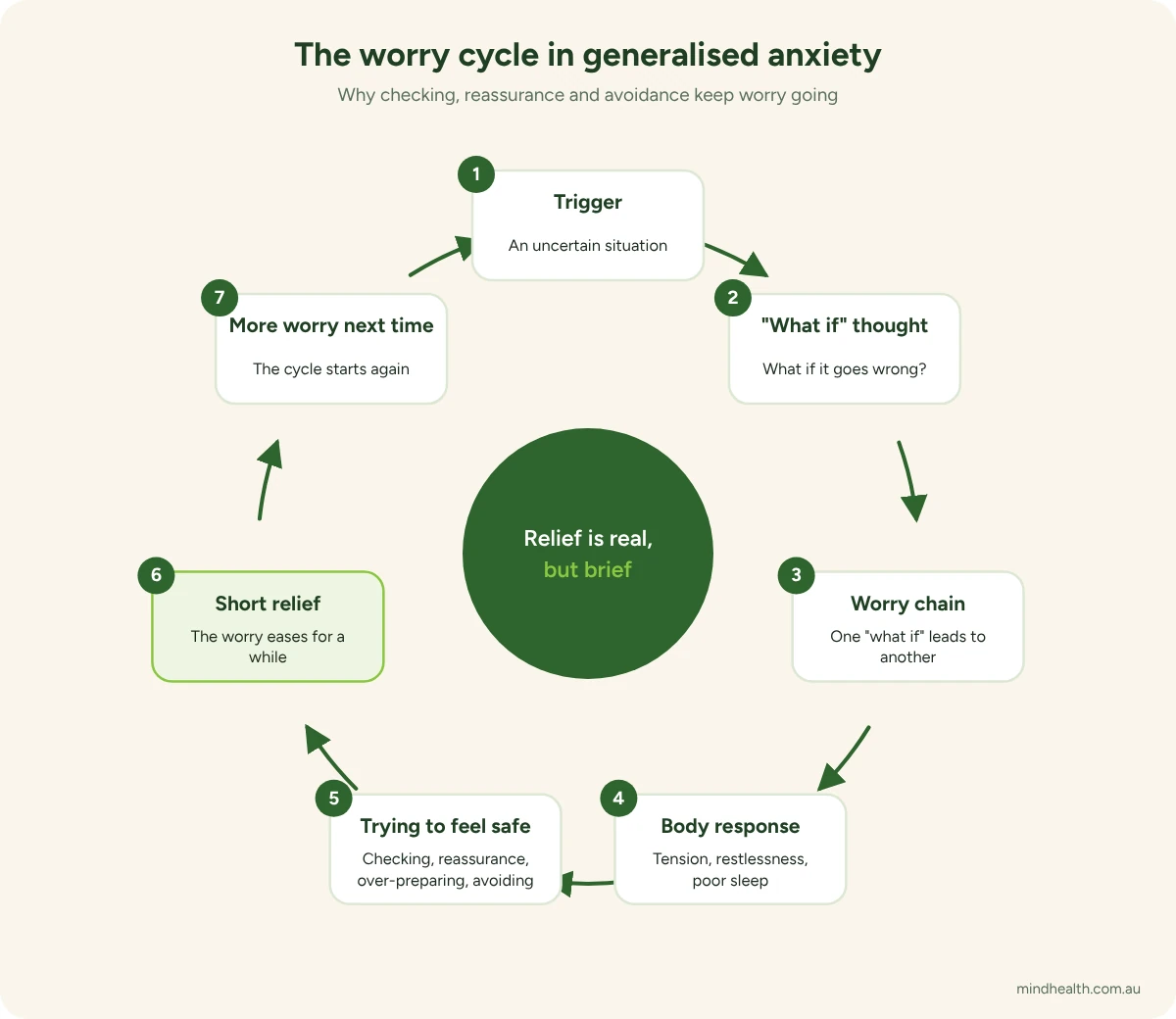
Worry can feel like preparation, but problem-solving ends in a decision or a next step. Worry tends to circle the same question without landing anywhere. Noticing which one you are doing is a good first skill.
How GAD differs from panic, health anxiety and depression
Anxiety conditions overlap, and an important way to tell them apart is to look at what the worry is about.3
- GAD: worry that things will go badly wrong across many areas of life, such as relationships, family, money, work, study, health and world events.3
- Panic disorder: repeated, unexpected panic attacks, with ongoing concern about having another attack or about what an attack means, such as a heart attack or losing control.3
- Health anxiety: concern about having a serious physical illness. When worry stays on a single concern like this, a diagnosis other than GAD may fit better.3
- Depression: persistent low mood and loss of interest are the main difficulties, and thinking tends to dwell on the past. In GAD the main feeling is anxiety and the thinking points to the future and to what might go wrong.3
GAD occurs alongside another condition more often than not, so clinical guidelines recommend that anyone with suspected GAD is also screened for depression.3 If you recognise yourself in more than one description, mention it at your appointment.
How GAD is assessed
A GP or psychologist will ask about your worry: how long it has been there, how much of the day it takes up and what it stops you doing. A thorough assessment also covers mood, substance use, medical conditions, personal and family history, past treatment, relationships and work, and your own goals.3
Medical conditions such as an overactive thyroid, and heavy use of substances including caffeine, need to be ruled out.3 That is one reason your GP is a sensible starting point.
You may be asked to complete a short questionnaire such as the GAD-7, a seven item measure developed and tested in primary care clinics.4 A score of 10 or more suggests that GAD may be present, and repeating the questionnaire over time is a way to track change.3 A questionnaire on its own is not a diagnosis. It is one piece of information alongside the conversation.
It helps to arrive with a few notes: when the worry started, what it tends to be about, how you are sleeping, and how much coffee and alcohol you are having.
What psychological support involves
Australian and New Zealand clinical guidelines recommend a collaborative approach that begins with education about GAD and advice on lifestyle factors, followed by specific treatment where needed.3 The options are CBT (8 to 12 face to face sessions, or a guided digital CBT program), medication, or a combination, chosen with your severity, preference and access in mind.3 The same guidelines recommend reviewing progress after 4 to 6 weekly sessions.3 Whether medication has a place for you is a decision to make with your doctor.
What CBT for GAD looks like
Cognitive behavioural therapy for GAD usually moves through three stages.3
- Understanding the pattern: noticing habitual worry, learning about GAD and tracking symptoms.
- Building skills: easing physical tension with progressive muscle relaxation and breathing training; questioning unhelpful thinking, such as overestimating how likely a bad outcome is and underestimating your ability to cope; learning to tolerate uncertainty; and using structured problem-solving to turn worries into solvable problems with action plans. It also means gradually facing what you avoid, for example sending an email without rereading it five times.
- Staying well: identifying early warning signs and making a plan to follow if they appear.
Acceptance and commitment therapy (ACT) is another psychological therapy that can be used for GAD.1
What the research found
A review that pooled 65 randomised trials involving 5,048 adults with GAD found that CBT and newer “third-wave” forms of CBT were associated with lower GAD symptoms than treatment as usual at the end of therapy.5 At 3 to 12 months after therapy, only CBT remained associated with a greater effect, and the authors suggested CBT as the first therapy to consider for GAD.5
Results differ from person to person. Therapy will not remove worry altogether, because some worry is a normal part of life, but it can help you manage symptoms so that worry is easier to live with.1 At Mind Health, our psychologists work with adults who live with persistent worry and anxiety.
Self-help that has evidence
Self-help does not replace an assessment, but these steps are supported by guidelines or research and can sit alongside professional care.
- Move your body: a review of 15 trials found that aerobic exercise reduced anxiety compared with waiting list control groups, though the studies were few and varied.6 Clinical guidelines for GAD mention cardio exercise for 30 minutes, three times a week.3
- Review caffeine, alcohol and sleep: healthy eating, good sleep and cutting back on caffeine, tobacco and alcohol are recommended as a starting point.3 Reducing coffee for a couple of weeks is an easy place to begin.
- Consider a guided online program: most online therapies follow CBT principles and usually do not need a GP referral.7 People are less likely to complete programs done entirely on their own, so one that includes some guidance may be easier to stick with.3
- Sort worries into two piles: write the worry down and ask whether you can do something about it now. If you can, plan one next step. If not, practise letting the thought be there without checking or seeking reassurance. This borrows from structured problem-solving, one of the skills used in CBT for GAD.3
When to see your GP or a psychologist
If worry is affecting your daily life, speak to your doctor.1 It is worth going early, because symptoms may not go away on their own.7 Fewer than half of people with GAD seek treatment.3
Consider making an appointment if:
- you have worried on most days for several months and find it hard to stop
- worry is affecting your sleep, concentration, work, study or relationships
- you rely on reassurance, checking or avoidance to get through the day
- you also notice low mood, panic attacks or drinking more to cope.
If your distress is severe or getting worse quickly, please see your GP promptly.
Your GP and the Mental Health Treatment Plan
Your GP can assess your symptoms and talk through your options. If you are eligible, they can prepare a Mental Health Treatment Plan (MHTP) and refer you to a psychologist.8 Under the Better Access initiative, Medicare benefits are available for up to 10 individual and 10 group therapy sessions per calendar year.8 The initial course is a maximum of 6 sessions, after which your referring doctor assesses whether further treatment is needed.8 The plan and referral need to come from the practice where you are registered for MyMedicare, or from your usual GP.8
When you book, it can help to say that you want to talk about your mental health, so that enough time is set aside.
Frequently asked questions
What is the difference between normal worry and generalised anxiety disorder?
Everyday worry is usually tied to a specific problem and eases once the problem passes. In generalised anxiety disorder the worry covers many areas of life, feels hard to control, is present on most days for 6 months or more, and comes with symptoms such as muscle tension, tiredness and poor sleep that get in the way of daily life.
How is generalised anxiety disorder diagnosed in Australia?
A GP or mental health professional talks with you about your worry, how long it has lasted and how it affects your life. They may also use a short questionnaire such as the GAD-7 and check for medical conditions, low mood and substance use. A questionnaire score alone is not a diagnosis.
Is generalised anxiety disorder the same as having panic attacks?
No. Panic disorder involves repeated, unexpected panic attacks and ongoing concern about having another one. Generalised anxiety disorder involves persistent worry about many everyday things, usually with ongoing tension and restlessness. Some people have both, which is one reason a full assessment with a GP or psychologist is useful.
How many sessions of CBT are usually recommended for GAD?
Australian and New Zealand clinical guidelines list 8 to 12 sessions of face to face CBT, or a guided digital CBT program, as an initial treatment option, with progress reviewed after 4 to 6 weekly sessions. The number that suits you depends on your symptoms, goals and circumstances, and is something to agree with your psychologist.
Can I get a Mental Health Treatment Plan for generalised anxiety disorder?
Possibly. Your GP assesses whether you are eligible and, if so, can prepare a Mental Health Treatment Plan and refer you to a psychologist. Under the Better Access initiative, Medicare benefits are available for up to 10 individual sessions per calendar year, beginning with an initial course of up to 6 sessions.
References
- Healthdirect Australia. (2024). Generalised anxiety disorder (GAD). https://www.healthdirect.gov.au/conditions/mental-health-conditions/generalised-anxiety-disorder-gad
- Australian Bureau of Statistics. (2023). National Study of Mental Health and Wellbeing, 2020-2022. ABS. https://www.abs.gov.au/statistics/health/mental-health/national-study-mental-health-and-wellbeing/2020-2022
- Andrews, G., Bell, C., Boyce, P., Gale, C., Lampe, L., Marwat, O., Rapee, R., & Wilkins, G. (2018). Royal Australian and New Zealand College of Psychiatrists clinical practice guidelines for the treatment of panic disorder, social anxiety disorder and generalised anxiety disorder. Australian and New Zealand Journal of Psychiatry, 52(12), 1109-1172. https://doi.org/10.1177/0004867418799453
- Spitzer, R. L., Kroenke, K., Williams, J. B. W., & Löwe, B. (2006). A brief measure for assessing generalized anxiety disorder: The GAD-7. Archives of Internal Medicine, 166(10), 1092-1097. https://doi.org/10.1001/archinte.166.10.1092
- Papola, D., Miguel, C., Mazzaglia, M., Franco, P., Tedeschi, F., Romero, S. A., Patel, A. R., Ostuzzi, G., Gastaldon, C., Karyotaki, E., Harrer, M., Purgato, M., Sijbrandij, M., Patel, V., Furukawa, T. A., Cuijpers, P., & Barbui, C. (2024). Psychotherapies for generalized anxiety disorder in adults: A systematic review and network meta-analysis of randomized clinical trials. JAMA Psychiatry, 81(3), 250-259. https://doi.org/10.1001/jamapsychiatry.2023.3971
- Aylett, E., Small, N., & Bower, P. (2018). Exercise in the treatment of clinical anxiety in general practice: A systematic review and meta-analysis. BMC Health Services Research, 18, 559. https://doi.org/10.1186/s12913-018-3313-5
- Beyond Blue. (n.d.). Treatments for anxiety. https://www.beyondblue.org.au/mental-health/anxiety/treatments-for-anxiety
- Department of Health, Disability and Ageing. (2025). Fact sheet for patients: Better Access to Psychiatrists, Psychologists and General Practitioners through the MBS initiative. Australian Government. https://www.health.gov.au/sites/default/files/2025-10/better-access-fact-sheet-patients_0.pdf
Related reading
- The anxiety toolkit: 7 evidence-based strategies that actually work
- Understanding panic attacks: What they are and how to manage them
- Health anxiety: When worry about illness takes over
- Doomscrolling: Why bad news is so hard to put down, and how to step back
This article is general information only and is not a substitute for personal advice from a qualified health professional. If you are concerned about your mental health, please speak with your GP or a psychologist.
Free · 5 to 10 minHow are you going, really?Take the Mind Health Check: a few short questions, then a private report.
More on anxiety & stress.
 Anxiety & Stress
Doomscrolling: Why bad news is so hard to put down, and how to step back
Why bad news is so hard to stop scrolling, what research links news overload to (stress, low mood,…
 Mind Health team12 min
 Anxiety & Stress
HSC exam stress: A guide for students and parents in NSW
Practical help for NSW Year 12 students and their parents: sleep, study rhythm, perfectionism, freezing in exams, what…
Mind Health team10 min Anxiety & Stress
Money worries and mental health: Coping with cost-of-living stress
How cost-of-living stress affects mood, sleep, relationships and thinking, with practical psychological steps and where to find free…
Mind Health team10 min
Your next step starts here.
Tell us what's going on and we'll match you with the right psychologist, usually after a free triage. No referral needed to begin.
