 The referral pathways guide


 Read with intention












 Meet the clinicians
Doomscrolling: Why bad news is so hard to put down, and how to step back

It is 11.40 at night. You picked up your phone to set an alarm. Forty minutes later you are still there, thumb moving, reading about a flood, a war, a court case and a warning about interest rates. You feel worse than when you started, and you keep going.
That habit has a name: doomscrolling. It means scrolling through bad news for longer than you meant to, even though it leaves you anxious, flat or wired. It is common, and it says more about how brains and news feeds work than about your willpower.
This article is for adults who feel worn down by the news, and for anyone who keeps checking and cannot work out why. It covers why bad news is so hard to put down, what research has found about heavy exposure to it, who is hit harder, and limits you can realistically keep.
Key takeaways
- People tend to react more strongly to bad news than to good news, and feeds are designed to hold attention. Doomscrolling is not a character flaw.
- In a 2026 national survey, more than two thirds of Australians said they avoid the news, yet more than half check it more than once a day.
- Studies link heavy exposure to distressing news with more stress, lower mood and poorer sleep. Most of this research shows a link, not a cause.
- Small, fixed limits are a practical start: set times, alerts off, a few trusted sources and a phone that charges outside the bedroom.
- If worry and checking are affecting your everyday life, it is worth talking with your GP or a psychologist.
Tired of the news, and still checking it
Australians are following the news closely and backing away from it at the same time. In a national survey of about 2,000 adults in early 2026, 56% said they access news more than once a day, and social media was the second most used source of news, just behind television.1 In the same survey, more than two thirds (68%) said they avoid the news. Avoidance was higher among women (71%) and higher again among 18 to 24 year olds (83%).1
Checking often while wanting to get away is what many people mean by news fatigue. It is not apathy. Often the dose has simply become too high.
If your tiredness is more about screens in general, our guide to digital burnout covers that. This article is about distressing news and the urge to keep checking it.
Why bad news is so hard to put down
Your attention goes to threat first
People tend to react more strongly to negative information than to positive information. Psychologists call this negativity bias. In an experiment across 17 countries, more than 1,100 people watched real television news stories while finger sensors tracked signs of arousal. On average, their bodies were more activated by negative stories than by positive ones, although individuals varied a great deal.2
The same pull shows up in what we click. An analysis of more than 22,000 headline experiments on one large news site found that, for a headline of average length, each extra negative word raised the click-through rate by 2.3%.3 The researchers measured clicks, not feelings.3
Uncertainty and the urge to check
When something feels threatening and unclear, looking for information is a normal way to cope, and it usually works.4 You look up the train strike, find out which line is affected, and relax.
It works less well when the threat is large, ongoing and outside your control. There is always another update, and no amount of reading delivers certainty.4 Each check brings a moment of relief or a fresh jolt, and both can send you back for more.
Feeds are built to keep you there
Social media feeds are sorted by software that overwhelmingly prioritises engagement, using signals such as how long you linger on a post, likes, shares and comments.5 These systems rarely tell positive engagement from negative engagement, so a post that upsets you can be treated as a reason to show you more like it.5 Infinite scroll, autoplay, push notifications and reward systems are among the features that may encourage compulsive use.5
A feed also has something of the poker machine about it. Most swipes turn up nothing much, then now and then one delivers something gripping. Rewards that arrive unpredictably are hard to walk away from.
Feed design is now a matter for regulators too. In March 2026 the rules behind Australia’s social media minimum age for under 16s were updated to take in recommender features alongside features such as endless feeds.5
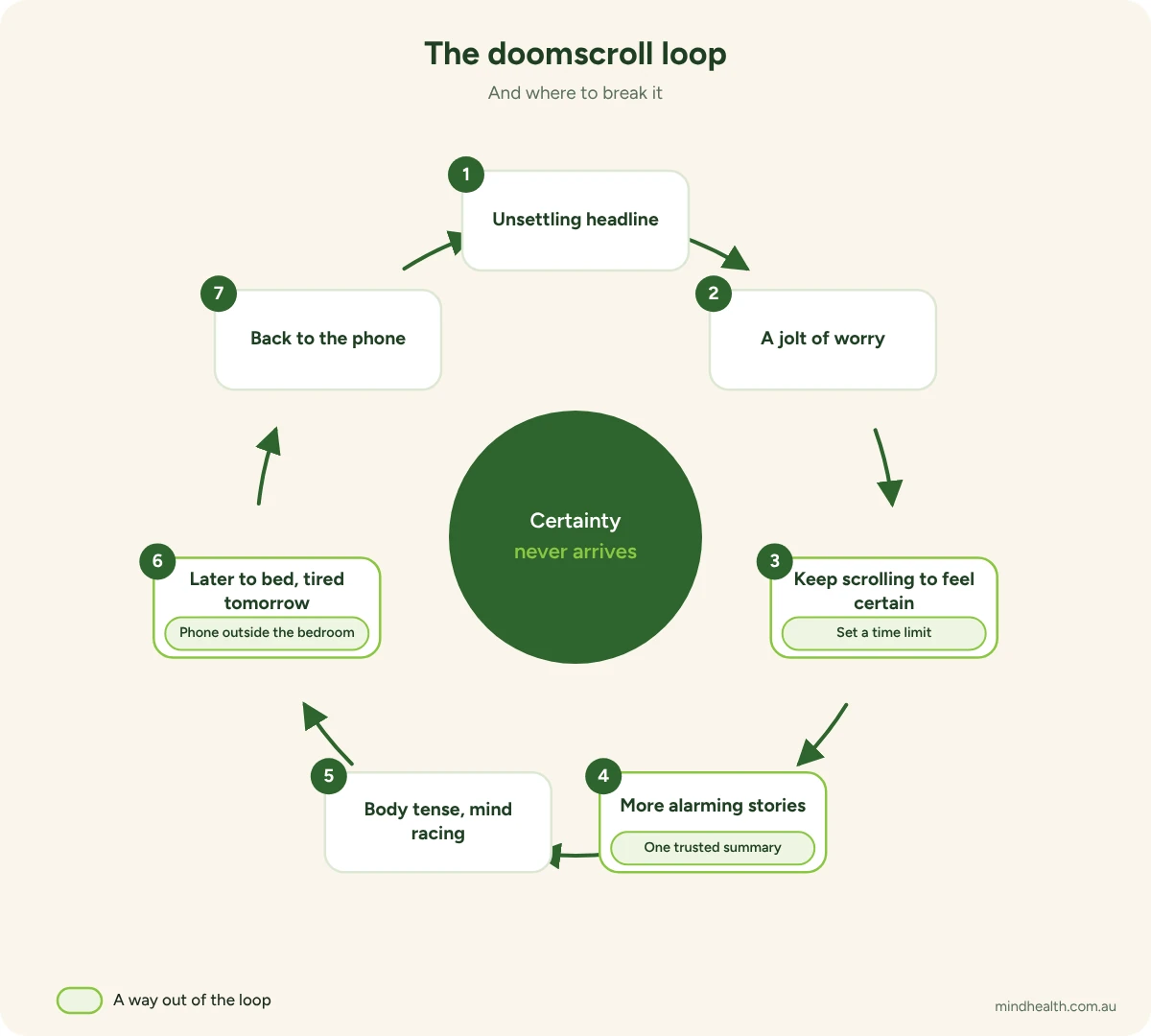
Put these together and you get a loop. An unsettling headline brings a jolt of worry. You keep scrolling to feel certain, the feed serves more alarming stories, your body tenses and your mind races. You get to bed later, wake up tired and reach for the phone again. The loop can be broken at several points.
What research has found about heavy exposure to distressing news
A caution first: most studies in this area are surveys. They show that heavy news exposure and distress travel together, not which comes first. It probably runs both ways.
- Mood can drop within minutes: In two experiments during the COVID-19 pandemic, adults who spent 2 to 4 minutes with pandemic news on social media reported lower positive mood straight afterwards than people who saw no news. Reading about acts of kindness did not have the same effect.4
- Some people get caught: A national survey of adults in the United States described a pattern called problematic news consumption: being absorbed in news stories, preoccupied by them, struggling to control your intake, and finding that it interferes with daily life. People with higher levels reported greater mental and physical ill-being, even after allowing for personality and overall news use.6
- Hours matter after disasters: After the 2013 Boston Marathon bombings, a survey of more than 4,600 adults in the United States found that six or more hours a day of bombing coverage in the following week was associated with more acute stress than direct exposure to the bombings.7
- It can become a cycle: Following a national sample for three years, the same researchers found that media exposure to the bombings predicted post-traumatic stress symptoms six months later. Those symptoms predicted more worry about future events, which predicted more media use and more acute stress after a later mass shooting.8
- Sleep takes a hit: In a survey of more than 45,000 university students in Norway, each extra hour of screen time after going to bed was linked with 59% higher odds of insomnia symptoms and about 24 minutes less sleep, whether the screen time was social media or something else. The study could not show cause, and people who sleep poorly may also reach for their phones.9
Who is more vulnerable?
Not everyone reacts to the news in the same way.2 After the Boston bombings, acute stress was higher among people with a history of anxiety or depression and among people who had lived through earlier violent events.7 People who are already worried about the future also tend to seek out more coverage.8
The pull is often stronger when a story is close to home: you have family in the affected region, or the event echoes something you have been through. If you already live with persistent worry, the urge to check can be especially hard to resist.
Staying informed or being flooded: How to tell the difference
The question is whether you are choosing the news or the news is choosing you.
You are probably informed when:
- you decided when to look, and you could stop when you planned to
- you learned something you can use, such as a road closure or a way to help
- your body settles soon after you put the phone down.
You are probably flooded when:
- you opened the app without deciding to
- you are reading the same story from five outlets
- your jaw is tight, your heart is quick or your stomach is churning
- you are going to bed later, or snapping at the people around you.
A quick test: after ten minutes, do you know anything new that changes what you will do today? If not, you are no longer getting information, only more of the feeling.
Limits you can actually keep
For most people the aim is not to avoid the news altogether. It is a dose you choose. The research above points towards being deliberate about what you take in,48 but specific news limits have not been tested head to head. Treat these steps as practical suggestions, and pick one or two.
- Set times: Choose one or two news windows a day, for example 15 minutes after breakfast and 15 after dinner, and use a timer. Skip the first minutes after waking and the last hour before bed.
- Turn off alerts: Switch off breaking news notifications and remove news widgets from your home screen, so that you go to the news and it does not come to you.
- Choose a few sources: Pick two or three outlets you trust, and prefer formats that end, such as a bulletin or a daily summary. In the national survey, 54% of people trusted the news they use themselves, compared with 21% who trusted news on social media.1
- Retrain your feed: Many platforms let you hide posts, mute accounts, tap “show less” or reset your recommendations.5
- A phone-free wind-down: Charge your phone outside the bedroom and use an ordinary alarm clock. Screen time in bed is linked with poorer sleep.9 If sleep is already a struggle, our page on sleep and insomnia has more.
- Notice your body: Before and after you open a news app, check your jaw, shoulders and breathing. Tension is a cue to stop, stand up and breathe out slowly.
- Do something useful with the worry: Ask whether there is anything you can do. If there is, do one small thing, such as donating or checking on a friend. If there is not, say so to yourself and return to what is in front of you. Active coping, such as helping others, may offset some of the emotional cost of bad news.4
What psychological support involves
Sometimes doomscrolling is one part of a wider pattern of anxiety. Working with a psychologist usually starts with an assessment: what you check, when, what you fear will happen if you do not, and how it is affecting your sleep, mood and daily life. From there, our psychologists work with you on a plan, which may include:
- Cognitive behavioural therapy (CBT): CBT is one of the psychological therapies used for anxiety. It is designed to change unhelpful thinking patterns, and its behavioural side involves gradually facing feared situations so that anxiety and avoidance ease.10 For compulsive checking, that can mean testing thoughts such as “if I do not check, I will miss something terrible” and practising putting off the check.
- Acceptance and commitment therapy (ACT): ACT is another therapy used for anxiety.10 It focuses on making room for uncertainty and uncomfortable feelings while you put your attention into what matters to you.
- Skills for the body: Relaxation, slow breathing and mindfulness can help you manage the physical side of anxiety.10
When to see your GP or a psychologist
Feeling upset by upsetting news is a normal reaction. It is worth getting support when anxiety symptoms are affecting your everyday life.10 Signs that the pattern has gone beyond a habit include:
- worry on most days that is hard to switch off
- checking that feels compulsive, with irritability or anxiety when you cannot check
- poor sleep that has gone on for more than a couple of weeks
- physical symptoms such as a racing heart, a churning stomach or shortness of breath10
- pulling back from work, people or places because of what you have read, or a low mood that lingers.
Your GP will ask about your symptoms and how they affect your daily life, and may do tests to rule out other health conditions. It can help to write down your symptoms before the appointment.10 Your GP can also talk with you about whether a Mental Health Treatment Plan (MHTP) is suitable. If your distress is severe or getting worse quickly, please see your GP promptly.
Frequently asked questions
What is doomscrolling?
Doomscrolling means scrolling through bad or distressing news for longer than you meant to, even though it is making you feel worse. It often happens late at night or first thing in the morning. It is a habit, not a diagnosis, and it says more about how attention and news feeds work than about your willpower.
Why do I keep scrolling when it makes me feel worse?
People tend to react more strongly to negative information than to positive information, so alarming headlines pull attention. When events feel uncertain, looking for more information is a normal way to cope, but a feed never reaches an end. Features such as infinite scroll, autoplay and push notifications may also encourage people to keep going.
Can doomscrolling cause anxiety?
Studies link heavy exposure to distressing news with more stress, lower mood and more worry, and one experiment found that a few minutes of pandemic news lowered mood straight away. Most of the research cannot show cause. The link probably runs both ways, because people who are already worried also tend to look for more coverage.
Should I stop following the news altogether?
Most people do not need to. The aim is a dose of news that you choose, not one a feed chooses for you. Small, fixed limits are a practical place to start: one or two set times a day, alerts switched off, two or three sources you trust, and a summary that has an end.
Does doomscrolling affect sleep?
It can. In a large survey of university students in Norway, each extra hour of screen time in bed was linked with higher odds of insomnia symptoms and about 24 minutes less sleep. The study could not show cause. A phone-free wind-down, with the phone charging outside the bedroom, is a simple change to try.
References
- Park, S., McGuinness, K., Lee, J., Fulton, J., Fujita, M., Nolan, D., Fisher, C., & Nardi, G. (2026). Digital News Report: Australia 2026. News and Media Research Centre, University of Canberra. https://doi.org/10.60836/rzwf-4j74
- Soroka, S., Fournier, P., & Nir, L. (2019). Cross-national evidence of a negativity bias in psychophysiological reactions to news. Proceedings of the National Academy of Sciences, 116(38), 18888-18892. https://doi.org/10.1073/pnas.1908369116
- Robertson, C. E., Pröllochs, N., Schwarzenegger, K., Pärnamets, P., Van Bavel, J. J., & Feuerriegel, S. (2023). Negativity drives online news consumption. Nature Human Behaviour, 7(5), 812-822. https://doi.org/10.1038/s41562-023-01538-4
- Buchanan, K., Aknin, L. B., Lotun, S., & Sandstrom, G. M. (2021). Brief exposure to social media during the COVID-19 pandemic: Doom-scrolling has negative emotional consequences, but kindness-scrolling does not. PLOS ONE, 16(10), e0257728. https://doi.org/10.1371/journal.pone.0257728
- eSafety Commissioner. (2026). Recommender systems: Tech trends position paper (May 2026). Australian Government. https://www.esafety.gov.au/sites/default/files/2026-05/Recommender-systems-position-paper-May2026.pdf
- McLaughlin, B., Gotlieb, M. R., & Mills, D. J. (2023). Caught in a dangerous world: Problematic news consumption and its relationship to mental and physical ill-being. Health Communication, 38(12), 2687-2697. (First published online August 2022.) https://doi.org/10.1080/10410236.2022.2106086
- Holman, E. A., Garfin, D. R., & Silver, R. C. (2014). Media’s role in broadcasting acute stress following the Boston Marathon bombings. Proceedings of the National Academy of Sciences, 111(1), 93-98. https://doi.org/10.1073/pnas.1316265110
- Thompson, R. R., Jones, N. M., Holman, E. A., & Silver, R. C. (2019). Media exposure to mass violence events can fuel a cycle of distress. Science Advances, 5(4), eaav3502. https://doi.org/10.1126/sciadv.aav3502
- Hjetland, G. J., Skogen, J. C., Hysing, M., Gradisar, M., & Sivertsen, B. (2025). How and when screens are used: Comparing different screen activities and sleep in Norwegian university students. Frontiers in Psychiatry, 16, 1548273. https://doi.org/10.3389/fpsyt.2025.1548273
- Healthdirect Australia. (2024). Anxiety. Last reviewed September 2024. https://www.healthdirect.gov.au/anxiety
Related reading
- The anxiety toolkit: 7 evidence-based strategies that actually work
- How to sleep better: 12 science-backed tips for the best snooze
- The science of stress management: Complete guide 2026
- Generalised anxiety disorder (GAD): When worry won’t switch off
This article is general information only and is not a substitute for personal advice from a qualified health professional. If you are concerned about your mental health, please speak with your GP or a psychologist.
Free · 5 to 10 minHow are you going, really?Take the Mind Health Check: a few short questions, then a private report.
More on anxiety & stress.
 Anxiety & Stress
Generalised anxiety disorder (GAD): When worry won’t switch off
What generalised anxiety disorder is, how it differs from everyday worry, panic and depression, and what assessment, CBT…
 Bülent Ada12 min
 Anxiety & Stress
HSC exam stress: A guide for students and parents in NSW
Practical help for NSW Year 12 students and their parents: sleep, study rhythm, perfectionism, freezing in exams, what…
Mind Health team10 min Anxiety & Stress
Money worries and mental health: Coping with cost-of-living stress
How cost-of-living stress affects mood, sleep, relationships and thinking, with practical psychological steps and where to find free…
Mind Health team10 min
Your next step starts here.
Tell us what's going on and we'll match you with the right psychologist, usually after a free triage. No referral needed to begin.
