 The referral pathways guide



 Read with intention












 Meet the clinicians
Health anxiety explained: When worry about illness becomes the illness

Everyone worries about their health sometimes. A new symptom, an unusual pain or a family member’s diagnosis prompts concern, and concern can motivate useful action like seeing a doctor.
Health anxiety is different. It is not ordinary concern. It is a persistent, often overwhelming preoccupation with the possibility of having or developing a serious illness, which continues despite medical reassurance and significantly impairs daily life.
People with health anxiety often feel embarrassed or frustrated with themselves. They know, on some level, that their worry is disproportionate. But knowledge rarely quiets health anxiety. The purpose of this article is to explain why it persists and what can actually help.
Key takeaways
- Health anxiety is persistent preoccupation with serious illness that continues despite medical reassurance.
- Checking and reassurance-seeking bring brief relief but maintain the anxiety long-term.
- “Dr Google” tends to amplify health anxiety because search results highlight rare, serious causes.
- CBT is the most researched treatment, and many people see meaningful improvement over a course of CBT.
What is health anxiety?
Health anxiety (known clinically as Illness Anxiety Disorder, or, where distressing physical symptoms are prominent, Somatic Symptom Disorder, in DSM-5-TR)2 is characterised by:
- High anxiety about having or developing a serious illness
- Persistent worry that normal body sensations are signs of serious disease
- Extensive checking behaviour (repeatedly checking the body for symptoms, repeated medical visits)
- Avoidance of health-related information or medical settings due to fear
- Little or no relief from normal medical assessment or reassurance
Health anxiety exists on a spectrum. Many people, particularly in the post-COVID era, experience subclinical health worry that does not meet full diagnostic criteria but still significantly affects their quality of life.

Why is health anxiety so common now?
Several factors have contributed to an increase in health anxiety presentations in recent years.
The COVID-19 pandemic created legitimate, widespread health threat. It also left many people with a heightened, ongoing vigilance about their bodies that hasn’t returned to baseline. For those with a pre-existing vulnerability to anxiety, the pandemic created ideal conditions for health anxiety to develop or intensify.
Access to medical information online. The ability to search symptoms online in seconds is genuinely useful. For people prone to health anxiety, it is also genuinely problematic. Search engines optimise for engagement, not reassurance. The rare serious diagnoses consistently appear prominently. “Dr Google” reliably transforms a tension headache into a possible brain tumour.
Symptom awareness without context. Knowing what symptoms can mean, in the absence of clinical knowledge about how to weight their significance, often drives more anxiety rather than less.
How health anxiety works: the maintenance cycle
Understanding why health anxiety persists requires understanding the cycle that maintains it. This cycle has several components:
Perceived threat → A normal bodily sensation (a racing heart, a headache, a lump) is interpreted as potentially dangerous.
Attention shift → Attention becomes focused on the body, increasing awareness of sensations that would otherwise not be noticed. (Focus on your left hand right now, and you’ll notice sensations you hadn’t noticed a moment ago.)
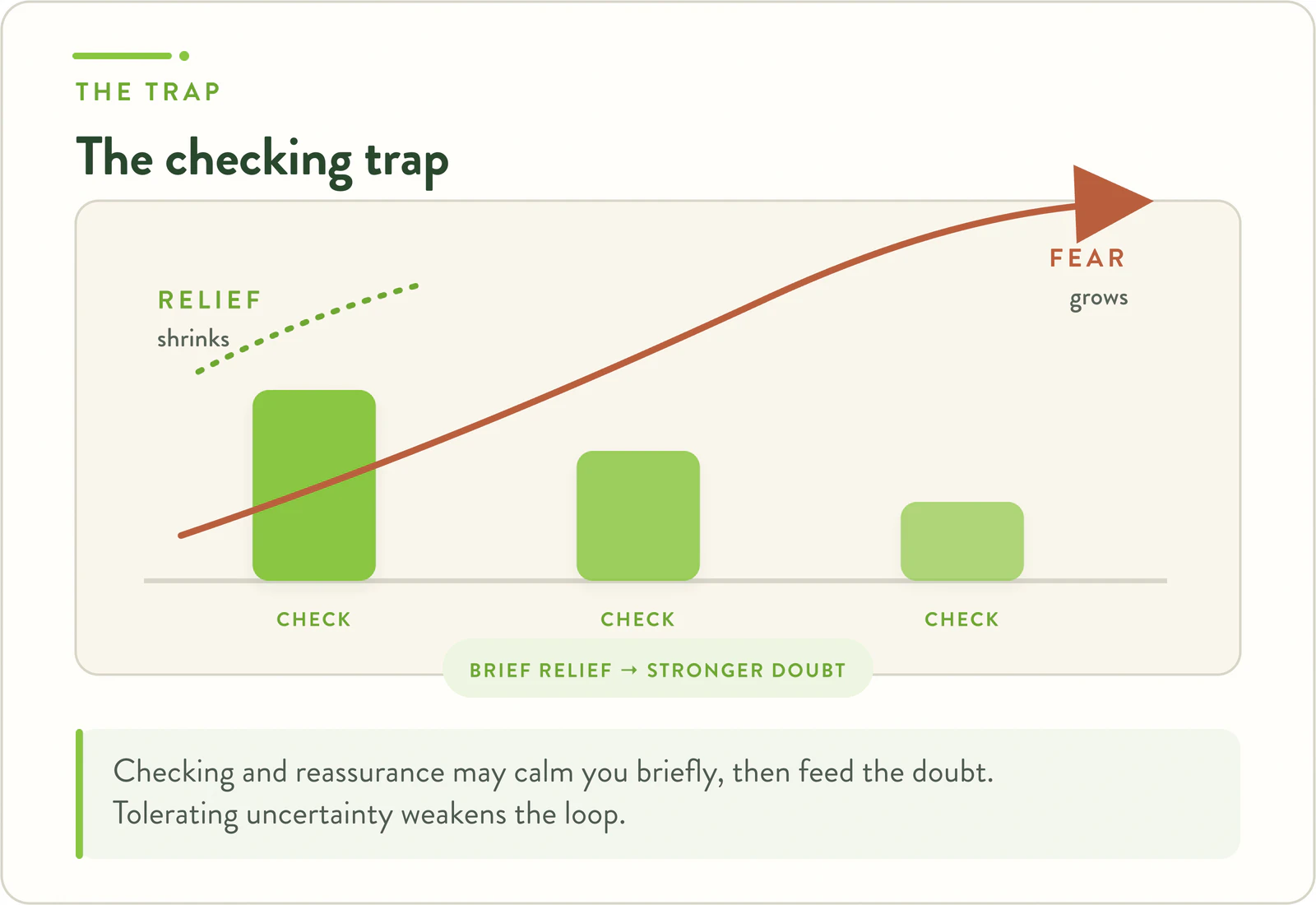
Checking and reassurance-seeking → To reduce anxiety, the person checks (examines the area, Googles symptoms, visits a doctor). Checking provides brief relief.
Temporary relief → return of anxiety → The relief is short-lived. Soon, uncertainty creeps back. “But what if the doctor missed something?” “The article said this could also be a sign of X.” Anxiety returns, often more intense.
Avoidance → Some people with health anxiety avoid medical appointments or information altogether, because they fear confirmation of the feared illness. This maintains anxiety differently: the feared illness is never disproved, so the worry persists without reality-testing.
This cycle is self-perpetuating. The checking and reassurance that seem like the obvious response to health anxiety are actually what maintain it. They provide temporary relief at the cost of long-term entrenchment.
The role of reassurance: why “just getting checked” doesn’t help long-term
This is perhaps the most counterintuitive aspect of health anxiety, and the one that sufferers and their families find most difficult to understand.
Seeking reassurance (from a doctor, a family member, or the internet) feels like the rational thing to do. But in health anxiety, reassurance functions like a safety behaviour: it provides enough relief to maintain the cycle, without addressing the underlying anxiety.
Each time reassurance brings relief, it reinforces the message that the threat was real and that checking was necessary. Over time, the amount of reassurance needed to achieve relief increases, and the threshold for anxiety decreases.
This does not mean medical attention should be avoided. It means that once a medical professional has assessed a symptom and not found a cause for concern, repeatedly re-presenting for reassurance about the same symptom is more likely to maintain anxiety than resolve it.
Effective treatment for health anxiety
Cognitive Behavioural Therapy (CBT)
CBT is the most extensively researched psychological treatment for health anxiety.1 It involves:
- Psychoeducation, which builds an understanding of the maintenance cycle
- Cognitive restructuring, which examines and modifies unhelpful beliefs about health, risk, and catastrophe
- Behavioural experiments, which test beliefs directly (e.g., “what actually happens if I don’t check this symptom for a week?”)
- Reducing safety behaviours, by gradually cutting back checking, body scanning, and reassurance-seeking
Exposure and Response Prevention (ERP)
For health anxiety that functions more like OCD (with compulsive checking), ERP may be incorporated. This involves deliberately facing health-related triggers and tolerating the uncertainty without engaging in checking behaviour.
Acceptance and Commitment Therapy (ACT)
ACT approaches health anxiety by shifting the goal from “feeling less anxious” to “living fully despite uncertainty.” This involves accepting the fundamental uncertainty of health and mortality, which is real for all of us, while committing to actions aligned with values rather than driven by fear.
“Reassurance fasting”
An informal but clinically-used strategy: a deliberately agreed period (typically 1–2 weeks) during which the person commits to not seeking reassurance from doctors, family, or the internet. This allows the natural decline of anxiety that occurs when checking is removed. The initial increase in discomfort is expected and temporary.
This strategy is best implemented with professional guidance rather than alone.
When to seek professional support
Consider seeking professional support if health anxiety is:
- Significantly interfering with daily life, work, or relationships
- Leading to frequent medical appointments without resolution
- Causing significant distress despite normal medical results
- Preventing you from engaging in activities for fear of triggering symptoms
A GP is a good starting point. They can refer you to a psychologist with a Mental Health Treatment Plan. Psychological therapy for health anxiety is effective, and many people see meaningful improvement over a course of CBT.1
Frequently asked questions
What is health anxiety?
Health anxiety, known clinically as Illness Anxiety Disorder, is a persistent and often overwhelming preoccupation with having or developing a serious illness, which continues despite medical reassurance and significantly affects daily life. It can involve interpreting normal body sensations as signs of disease, extensive checking, or avoidance of medical settings. It exists on a spectrum, and many people experience distressing subclinical worry.
Why does getting checked not relieve health anxiety?
In health anxiety, reassurance functions like a safety behaviour. It provides enough relief to keep the cycle going without addressing the underlying anxiety. Each time relief follows checking, it reinforces the message that the threat was real and checking was necessary. Over time more reassurance is needed for the same relief, so repeatedly re-presenting for the same symptom maintains anxiety.
Why has health anxiety become more common?
Several factors contribute. The COVID-19 pandemic created widespread health threat and left many people with heightened ongoing vigilance about their bodies. Easy access to medical information online is useful but problematic, as search engines optimise for engagement and surface rare serious diagnoses prominently. Knowing what symptoms can mean, without clinical context for weighting them, often increases anxiety rather than easing it.
What treatment is recommended for health anxiety?
Cognitive Behavioural Therapy is the most extensively researched treatment. It includes understanding the maintenance cycle, examining unhelpful beliefs about health and risk, behavioural experiments, and gradually reducing checking and reassurance-seeking. Exposure and Response Prevention may help where checking is compulsive, and ACT focuses on living fully despite uncertainty. Many people see meaningful improvement over a course of CBT.
Should I stop seeing doctors if I have health anxiety?
No. New or changing physical symptoms should always be assessed by a medical professional. The aim is not to avoid medical care but to recognise that once a symptom has been properly assessed and no cause for concern found, repeatedly seeking reassurance about the same symptom tends to maintain anxiety. Strategies like a brief reassurance fast are best done with professional guidance.
Related reading
This article is for informational purposes only and is not a substitute for professional medical or mental health advice. New or changing physical symptoms should always be assessed by a medical professional.
Get professional support
Cognitive behavioural therapy at Mind Health
CBT is one of the most researched and effective approaches for anxiety, depression, and many other conditions.
Medicare rebates available with a Mental Health Treatment Plan · Telehealth appointments Australia-wide
Helpful Australian resources
- Beyond Blue: Support for depression, anxiety and related conditions. Call 1300 22 4636.
- Lifeline Australia: Crisis support and suicide prevention. Call 13 11 14 (24/7).
- Medicare Mental Health: Australian Government mental health gateway. Call 1800 595 212.
- Black Dog Institute: Research-based resources on depression, bipolar disorder, and PTSD.
- SANE Australia: Support for people living with complex mental illness. Call 1800 187 263.
References
- Axelsson, E., & Hedman-Lagerlöf, E. (2019). Cognitive behavior therapy for health anxiety: Systematic review and meta-analysis of clinical efficacy and health economic outcomes. Expert Review of Pharmacoeconomics & Outcomes Research, 19(6), 663–676. https://doi.org/10.1080/14737167.2019.1703182
- American Psychiatric Association. (2022). Diagnostic and statistical manual of mental disorders (5th ed., text rev.). American Psychiatric Association Publishing. https://doi.org/10.1176/appi.books.9780890425787
More on anxiety & stress.
 Anxiety & Stress
Generalised anxiety disorder (GAD): When worry won’t switch off
What generalised anxiety disorder is, how it differs from everyday worry, panic and depression, and what assessment, CBT…
 Bülent Ada12 min
 Anxiety & Stress
Doomscrolling: Why bad news is so hard to put down, and how to step back
Why bad news is so hard to stop scrolling, what research links news overload to (stress, low mood,…
Mind Health team12 min Anxiety & Stress
HSC exam stress: A guide for students and parents in NSW
Practical help for NSW Year 12 students and their parents: sleep, study rhythm, perfectionism, freezing in exams, what…
Mind Health team10 min
Your next step starts here.
Tell us what's going on and we'll match you with the right psychologist, usually after a free triage. No referral needed to begin.
