 The referral pathways guide



 Read with intention












 Meet the clinicians
Mindfulness: What it is, what the evidence says and how to practise

Mindfulness may be the most heavily marketed idea in modern mental health. Depending on who is selling it, it will dissolve your stress, rewire your brain, boost your productivity and deliver you to a state of permanent calm. The hype is a pity, because underneath it sits something genuinely useful: a trainable mental skill with a real, if modest, evidence base. This guide sets out what mindfulness actually is, what the research does and does not support, and how to practise it in a way that survives contact with reality.
Key takeaways
- Mindfulness is attention training, meaning paying attention on purpose, in the present moment and non-judgementally, and it is not relaxation or emptying the mind.
- Research supports small to moderate benefits for anxiety, depression and pain, with the strongest evidence for mindfulness-based cognitive therapy in preventing depressive relapse.
- Start with five minutes of a practice such as a breath anchor or body scan, because consistency matters more than duration.
- It does not work for everyone, and people with a trauma history, a severe depressive episode or past psychosis should learn it with a qualified clinician.
- Consider seeing a psychologist if stress or low mood has persisted for weeks and is affecting your work, sleep or relationships, or if meditation consistently leaves you feeling worse.
What mindfulness actually is
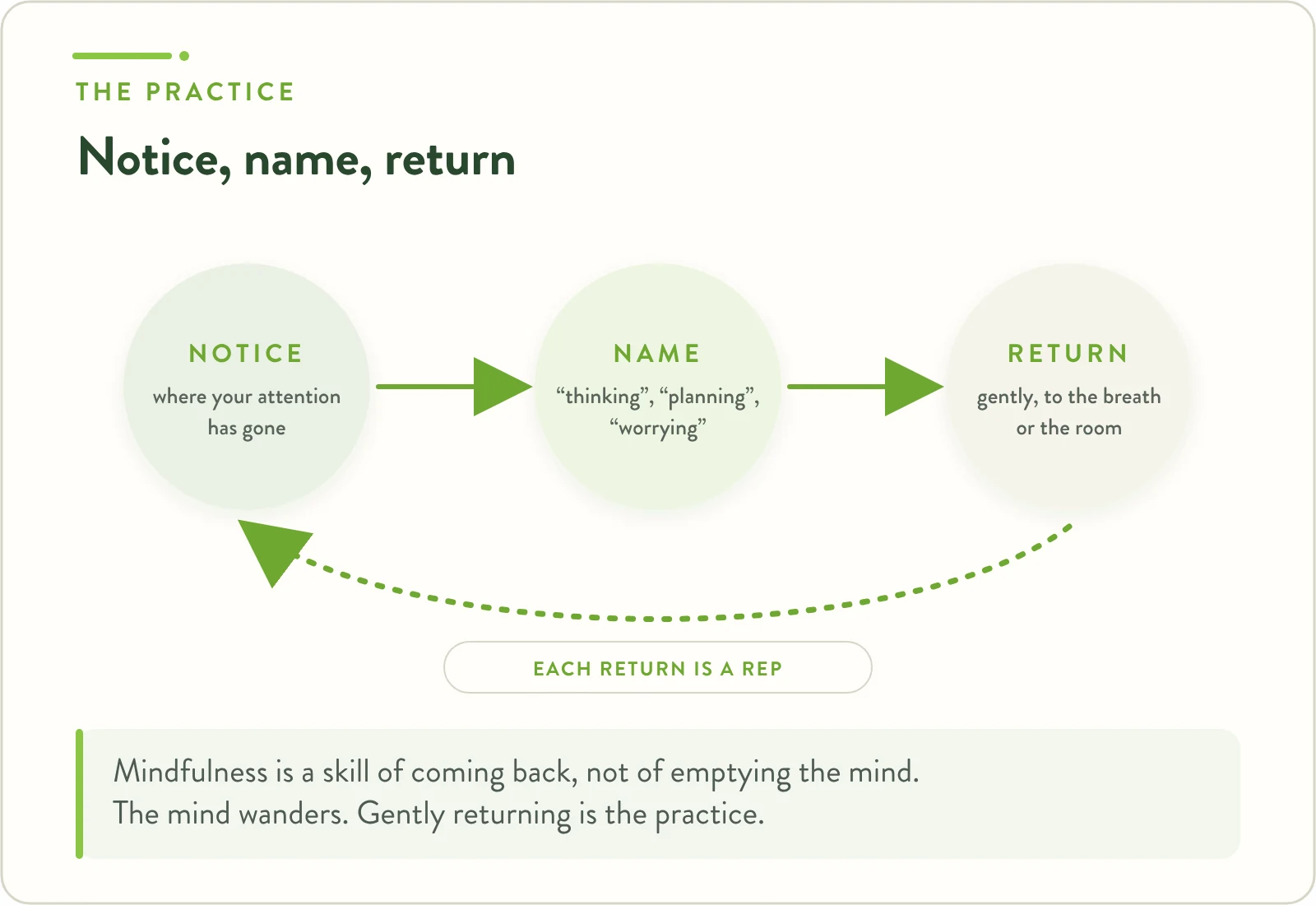
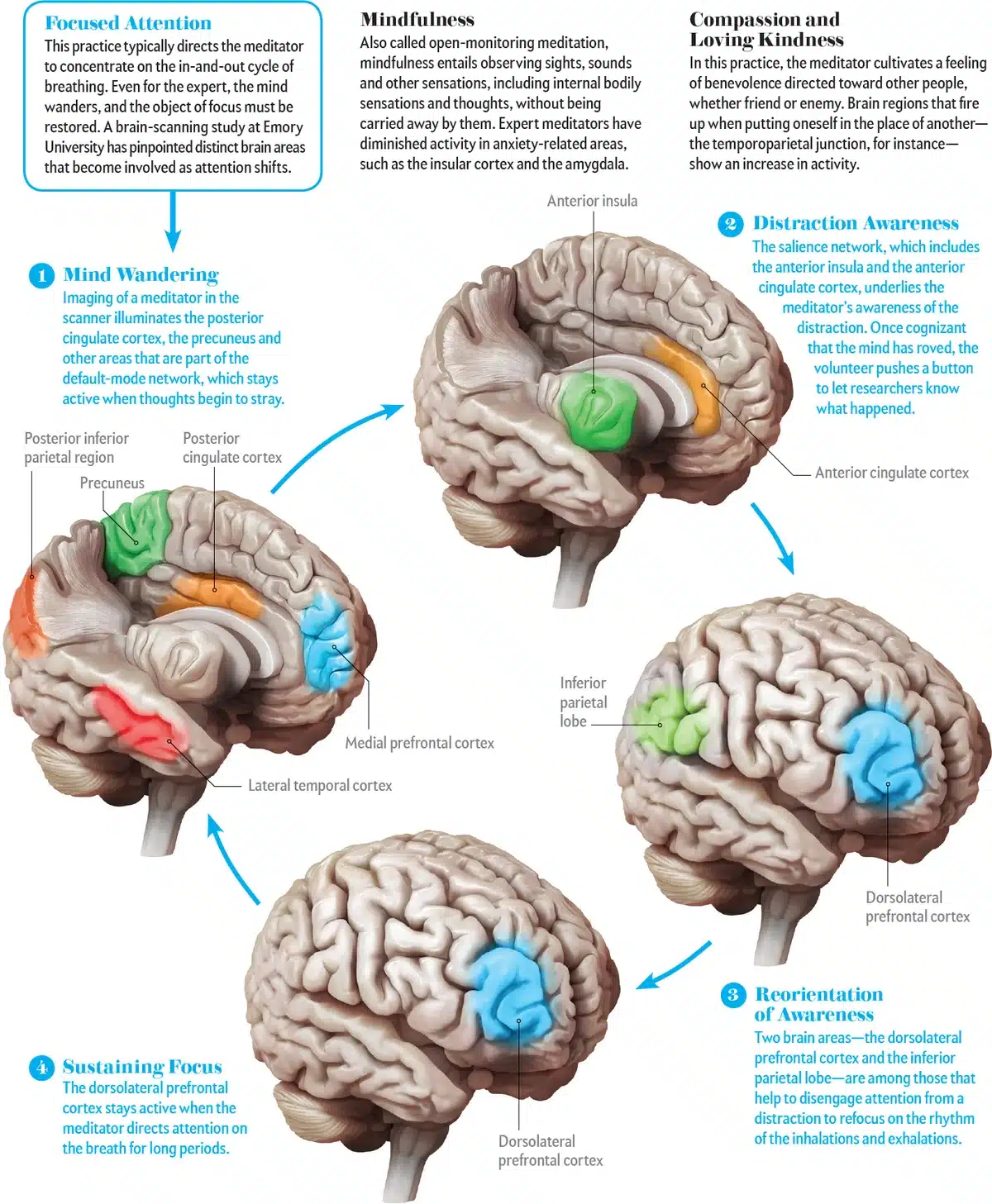
Strip away the incense and the app subscriptions and mindfulness is attention training. Jon Kabat-Zinn, who developed Mindfulness-Based Stress Reduction (MBSR) at the University of Massachusetts Medical School in 1979, defined it as paying attention on purpose, in the present moment, and non-judgementally.3 In practice, that means three repeatable moves: you place your attention somewhere (often the breath), you notice when it has wandered off, and you bring it back without berating yourself.
Two things mindfulness is not. It is not relaxation. Relaxation is sometimes a pleasant side effect, but the practice itself is about noticing whatever is present, and that may be tension, boredom or irritation. Sitting down to meditate and discovering how agitated you are is the practice working, not failing. And it is not emptying the mind. Minds produce thoughts the way hearts produce beats; nobody can switch that off. The skill is noticing thoughts as mental events and choosing where attention goes next, rather than being dragged along by every one of them.
What the research genuinely supports
Mindfulness research is enormous, uneven and frequently oversold. Here is a fair reading of it.
Stress, anxiety and low mood. The most careful large review remains a 2014 meta-analysis by Goyal and colleagues in JAMA Internal Medicine, which examined 47 randomised trials of meditation programs. It found moderate evidence that structured mindfulness programs such as MBSR improve anxiety, depression and pain, with effects that were small to moderate in size.1 Notably, it found no evidence that meditation outperformed other active treatments such as exercise, medication or other behavioural therapies.1 Helpful, in other words. Not uniquely or magically so.
Preventing depression from coming back. This is where the evidence is strongest. Mindfulness-Based Cognitive Therapy (MBCT), developed by Zindel Segal, Mark Williams and John Teasdale, combines mindfulness training with cognitive therapy principles and was designed specifically for people with recurrent depression.4 A 2016 individual patient data meta-analysis by Kuyken and colleagues in JAMA Psychiatry, pooling nine randomised trials and 1,258 patients, found that MBCT reduced the risk of depressive relapse over 60 weeks compared with usual care, with benefits that held up against active comparisons including maintenance antidepressants.2 People with more severe residual symptoms appeared to benefit most.2 MBCT now features in several international clinical guidelines for recurrent depression.
The honest caveats. Much of the wider literature consists of small studies with short follow-up, weak control groups and enthusiastic authors. Popular claims about meditation dramatically “rewiring the brain” rest on small neuroimaging studies that have not always replicated. Evidence for standalone mindfulness apps is thinner than for structured, teacher-led programs. None of this makes mindfulness worthless; it makes it a moderately effective skill rather than a miracle, and that is still worth having.
Common misconceptions
- “I tried it and I couldn’t stop thinking, so I’m bad at it.” Noticing that your mind wandered is the practice. Each time you notice and return, you have done one repetition, the mental equivalent of one lift in the gym.
- “Mindfulness means being calm all the time.” The aim is awareness, not perpetual serenity. Practised people still feel anger, grief and stress; they tend to notice these states earlier and react to them less automatically.
- “It’s a religious practice.” Mindfulness has roots in Buddhist contemplative traditions, and it is fair to acknowledge that lineage. Clinical programs like MBSR and MBCT, however, are secular and require no beliefs.
- “More is always better.” There is no evidence that marathon sessions outperform brief consistent practice for everyday purposes, and for some people intensive retreats can be destabilising.
- “It works for everyone.” It does not, and reputable researchers say so plainly. If mindfulness has not helped you, that is data, not a personal failing. Other approaches may suit you better.
How to actually practise
Forget the hour of lotus-position silence. Start with five minutes.
- Five-minute breath anchor. Sit comfortably, set a timer, and rest your attention on the physical sensation of breathing, such as air at the nostrils or the rise and fall of the belly. Your mind will wander within seconds; that is normal. When you notice, briefly acknowledge where it went (“planning”, “worrying”) and return to the breath. Expect to do this dozens of times. That is the workout.
- Five-minute body scan. Move your attention slowly from feet to head, noticing sensations (pressure, warmth, tingling, numbness) without trying to change them. Useful for people who find the breath too subtle to hold onto.
- Sound as anchor. Sit and simply listen, letting sounds arrive and pass without labelling them good or bad. A good option when internal focus feels uncomfortable.
Informal practice matters just as much. Pick one routine activity a day, such as the first coffee, the shower or the walk to the station, and give it your full sensory attention: temperature, texture, sound, smell. No timer, no app, no extra time required. Consistency beats duration: five minutes daily builds the skill more reliably than forty minutes once a fortnight.
Who should be cautious
The wellness industry rarely mentions this, but mindfulness is not universally benign. Research led by Willoughby Britton at Brown University followed 96 people through eight-week mindfulness-based programs: 58 per cent reported at least one unpleasant meditation-related effect, 37 per cent reported an effect that interfered with their daily functioning, and between 6 and 14 per cent reported lasting bad effects.5
The clearest concern involves trauma. For people with trauma histories, closing the eyes and turning attention inward to the breath and body can trigger intrusive memories, panic or dissociation rather than calm.6 This is well recognised enough to have its own clinical literature: trauma-sensitive mindfulness, developed most prominently by psychotherapist and educator David Treleaven, adapts practice so it stays within a person’s window of tolerance. Sensible modifications include keeping the eyes open, using external anchors such as sound or the feet on the floor rather than the breath, keeping practices short, and giving yourself explicit permission to stop at any time.6
If you have a trauma history, are currently in a severe depressive episode, or have experienced psychosis, mindfulness is best learned with a qualified clinician who can tailor the practice, rather than alone with an app. Feeling activated by meditation does not mean something is wrong with you; it means the standard instructions were not written with your nervous system in mind.
Mindfulness within evidence-based therapies
In clinical practice, mindfulness rarely stands alone. It works as a component within structured therapies:
- MBCT is an eight-week group program combining mindfulness training with cognitive therapy, with its strongest evidence in preventing relapse for people who have had repeated episodes of depression.
- Acceptance and Commitment Therapy (ACT) uses present-moment awareness and “defusion” from unhelpful thoughts, not as ends in themselves but in the service of acting on your values even when difficult feelings are present.
- Dialectical Behaviour Therapy (DBT) treats mindfulness as the core skill underpinning its modules on emotion regulation, distress tolerance and interpersonal effectiveness.
A psychologist can help you work out whether one of these structured approaches fits your situation better than generic meditation practice.
When to seek support
Mindfulness is a skill, not a treatment plan. Consider seeing a psychologist if stress or low mood has persisted for weeks and is affecting your work, sleep or relationships; if you have had repeated episodes of depression; if stress is tipping into burnout; or if your attempts at meditation consistently leave you feeling worse rather than steadier. These are situations where a proper assessment matters, and where, if mindfulness is appropriate at all, it works best inside a broader, tailored plan. You can request an appointment with our psychologists in person or online.
Frequently asked questions
Is mindfulness the same as meditation?
Not quite. Meditation is the formal training (set time, set practice), while mindfulness is the quality of attention you are training, which can then show up while eating, walking or in a difficult conversation. Meditation is to mindfulness roughly what gym sessions are to fitness.
How long before I notice any benefit?
Be wary of anyone who gives you a guaranteed timeline. The structured programs with the best evidence, MBSR and MBCT, run for eight weeks with regular practice, and most trials measure outcomes on that scale. Some people notice small changes sooner, such as catching a spiral of worry earlier, while others need longer, and some conclude mindfulness is not their tool. All of those outcomes are normal.
Can mindfulness replace therapy or medication?
For most people, no. It is best understood as one skill within a broader approach, not a substitute for treatment. MBCT is a partial exception in relapse prevention for recurrent depression, but that decision should be made with your treating clinicians, and you should never stop a prescribed medication without talking to your prescriber first.
If you would like to learn mindfulness properly, with the hype removed and the practice adapted to you, Mind Health’s psychologist-led Mindfulness-X program is available in Parramatta and via telehealth Australia-wide.
References
- Goyal, M., et al. (2014). Meditation programs for psychological stress and well-being: A systematic review and meta-analysis. JAMA Internal Medicine, 174(3), 357–368.
- Kuyken, W., et al. (2016). Efficacy of mindfulness-based cognitive therapy in prevention of depressive relapse: An individual patient data meta-analysis from randomized trials. JAMA Psychiatry, 73(6), 565–574.
- Kabat-Zinn, J. (2013). Full Catastrophe Living: Using the Wisdom of Your Body and Mind to Face Stress, Pain, and Illness (rev. ed.). Bantam Books.
- Segal, Z. V., Williams, J. M. G., & Teasdale, J. D. (2013). Mindfulness-Based Cognitive Therapy for Depression (2nd ed.). Guilford Press.
- Britton, W. B., et al. (2021). Defining and measuring meditation-related adverse effects in mindfulness-based programs. Clinical Psychological Science, 9(6), 1185–1204.
- Treleaven, D. A. (2018). Trauma-Sensitive Mindfulness: Practices for Safe and Transformative Healing. W. W. Norton.
More on wellbeing & self.
 Wellbeing & Self
Chronic pain and mental health: How psychology helps with persistent pain
How persistent pain, stress, sleep and mood affect each other, what pain psychology involves, and how to get…
Mind Health team12 min Wellbeing & Self
AI companions: When a chatbot becomes your 2am confidant
Why people confide in AI chatbots at 2am, what the research and Australia's new rules say, and how…
 Bülent Ada12 min
 Wellbeing & Self
Together we thrive: Connection and Mental Health Month 2026
The 2026 Mental Health Month theme is Together We Thrive. Here is what the evidence says about loneliness,…
Mind Health team10 min
Your next step starts here.
Tell us what's going on and we'll match you with the right psychologist, usually after a free triage. No referral needed to begin.
