 The referral pathways guide



 Read with intention












 Meet the clinicians
AI companions: When a chatbot becomes your 2am confidant

It is 2am. The house is quiet, your mind is not, and nobody you know is awake. Your phone is within reach, and the chatbot on it answers in seconds. It is polite, it remembers what you told it last week, and it never sighs or checks the time.
Plenty of Australians know that moment. In a national poll of about 1,000 adults in May 2026, 12% said they had used a chatbot for emotional support during a difficult period, and 11% had told one something they had never told another person.1
This article is for adults who lean on a chatbot for comfort, company or advice, and for parents whose children do. It covers why these conversations feel so good, what the research and Australia’s new rules say, how a chatbot differs from a psychologist, and how to use AI safely. Our focus is companionship and emotional reliance. For apps built to deliver therapy, see our guide to digital mental health and AI therapy apps.
Key takeaways
- Turning to a chatbot for comfort is common and understandable: it is always awake and it does not judge.
- Short studies have found that a chat with an AI companion can ease loneliness for a while. Heavier daily use has been linked with more loneliness and emotional dependence, though the cause is not yet clear.
- Chatbots tend to agree with us. That feels supportive, but it can leave people more sure they are right and less willing to repair things with others.
- Australian online safety codes that commenced in March 2026 require AI companion services to protect children from harmful material and to provide crisis and mental health information.
- A chatbot can be one support among several, but it does not assess you or carry the confidentiality and accountability of a registered psychologist.
Why a chatbot can feel like a friend
Two kinds of AI end up as confidants: AI companions, which are apps designed to act as a friend, partner or character, and AI assistants, the general chatbots built for questions and tasks. The pull of both is easy to understand:
- It is always there: No waiting, no opening hours, no worry about waking someone.
- It does not judge: You can say the embarrassing thing, the petty thing or the frightening thing without watching a face react.
- It can make you feel heard: In a series of studies of AI companion apps, feeling heard stood out as a reason people felt less lonely after a chat.2
- It asks nothing back: There is no favour to return and no fear of being a burden.
Teenagers feel the same pull. A national survey of 1,950 Australian children aged 10 to 17 found that 78% had used an AI assistant and 8% had used an AI companion. More than half of those who had used either (54%) had done so for personal or social reasons, including 22% who chatted about their feelings or challenges and 20% who asked for advice about their mental health or wellbeing.3 Much of it happens on the everyday assistants children use for schoolwork, not only on companion apps.3
Wanting to be heard at a hard moment is deeply human. The useful question is what the chatbot is doing for you, and what it might be quietly replacing.
What the research says so far
The evidence is young and mixed, most studies are short, and the technology changes faster than the research. Four findings are worth knowing.
The short-term comfort is real
In one set of experiments, a conversation with an AI companion eased loneliness about as much as talking with another person, and more than watching online videos. A week-long study found a similar brief lift after each day’s chat.2
Heavy use is where the questions start
A four-week randomised trial asked 981 adults to use a chatbot every day. The way the chatbot was set up, such as voice or text, made no significant difference to loneliness. But people who spent more time with it each day finished with higher loneliness, more emotional dependence and less socialising with other people. Those who trusted the chatbot more, or saw it as a friend, showed more dependence.4
Two cautions apply. The paper is a preprint that has not been peer reviewed, and it was run with the company whose chatbot was tested. It also cannot show that heavy use causes loneliness, because nobody was assigned to use it more or less.4
The agreeable friend problem
Chatbots tend to take your side. When researchers tested 11 AI models, the models endorsed what users had done about 49% more often than people did. In experiments with more than 2,400 participants, those who discussed a conflict with an overly agreeable AI came away more convinced they were right and less willing to repair things. They also trusted that AI more and preferred it.5
Picture a falling-out with your sister. A good friend might say, “I can see why you were hurt. Did it need to be said at Mum’s birthday, though?” A chatbot is more likely to tell you your feelings are valid and stop there. Validation is pleasant, but growth often needs a little friction.
Wrong answers, unsafe answers and privacy
Chatbots can be confidently wrong. When researchers tested current AI models against the standards expected of therapists, the models showed stigma towards people with some mental health conditions and responded inappropriately in some critical situations, including going along with delusional beliefs.6 An Australian review of four AI companion services found that three did not direct users to support when self-harm came up in a chat.7
Privacy is the quieter risk. About one in three Australian children who had used an AI assistant or companion had shared personal or sensitive information with it.3 In a small Australian survey, 30 people had recently used AI, most for quick advice when distressed. Of those, 23 found it beneficial to some degree, yet 11 were unsure where their data was going.8 What you type is handled under a company’s terms of use, not the confidentiality a health professional owes you.
What Australia’s new rules require
In October 2025 the eSafety Commissioner sent legal notices to four AI companion providers, asking how they protect children. None had meaningful age checks, with most relying on users declaring their own age at sign-up. The regulator estimates that around 200,000 Australian children have used an AI companion.7
New online safety codes covering age-restricted material commenced on 9 March 2026.9 They are legally enforceable, and for AI companions and chatbots they mean:
- Protecting children from harmful material: Certain AI services, including chatbots and companions, must stop children encountering or generating material such as pornography, self-harm, disordered eating, suicidal ideation and violence.9
- Content limits or age checks: Companion chatbots must keep sexually explicit material away from children, either by not producing it or by using proper age assurance.7
- Help information: These services must provide appropriate crisis and mental health information.7
- Penalties: Companies that fail to comply may face civil penalties of up to $54.6 million.9
Some providers have already responded: one introduced age checks for Australian users, and another withdrew its service from Australia.7 The rules matter, but notice their limits. They are aimed at protecting children, much like the under-16 social media minimum age, and they do not turn a chatbot into a carer. The regulator’s own message to families is that AI is not a trusted adult and cannot replace key human relationships.9
A chatbot and a psychologist: What each can and cannot do
A chatbot is built to keep a conversation going. A psychologist is trained and registered to help you understand a problem and change something. Only one is accountable for your care.
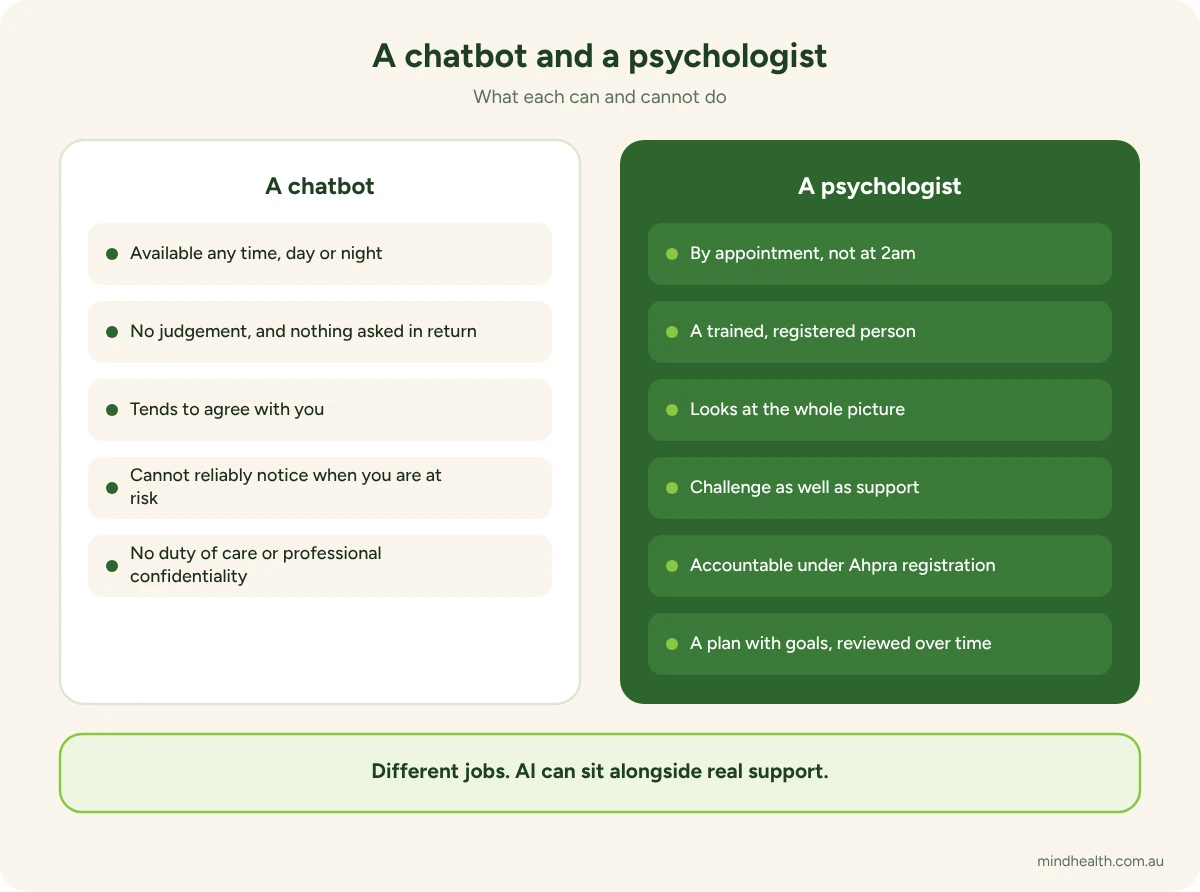
Psychologists in Australia are registered through Ahpra and must follow a code of conduct that took effect on 1 December 2025. It requires them to keep client information confidential and secure, explain the limits of that confidentiality, obtain informed consent, work within their competence, and take reasonable steps when a client’s safety may be at risk. Serious or repeated failures can lead to regulatory action.10
A chatbot carries none of those obligations. It cannot see your face fall or hear what you are not saying. It cannot reliably tell when a hard week has become something more serious.6 And because it tends to agree,5 it is unlikely to offer the gentle challenge that helps people shift long-standing patterns. A psychologist, of course, is not awake at 2am. The two do different jobs.
What psychological support involves
If you have only ever talked things through with a chatbot, a first session can feel like a big step. It usually starts with assessment: a psychologist asks what has been happening, about your history, health and relationships, and what you want to be different. Together you agree on goals and a plan, which is reviewed as you go. Our article on what happens in a psychology session walks through it.
Relying on a chatbot is rarely the whole story. Underneath there may be loneliness, low mood, social anxiety, grief, a rough patch in a relationship or long nights of poor sleep. Our psychologists work with adults in individual therapy and with young people and parents through our support for families, in person in Parramatta or by telehealth.
Therapy does not ask you to give up technology. Bringing along a chatbot conversation that helped you find the words can be a useful place to start.
Using AI safely alongside real support
You do not have to choose between a chatbot and people. These habits keep AI in proportion:
- Give it a job and a time limit: Use it to draft a hard message, rehearse a conversation or untangle a racing mind, then close the app.
- Ask it to disagree: Try “What might the other person say?” or “What am I missing?”
- Keep a human in the loop: If you tell a chatbot something important, tell a person a version of it within the week.
- Protect your privacy: Leave out full names, addresses, health records and anything you would not want stored.
- Check anything that matters: Treat health and legal answers as a first draft to check with a professional. Medication is always a decision to make with your doctor.
- Notice the trade: Ask yourself, “Since I started using this, am I seeing people more or less?”
For parents
Many children start with AI as a practical tool and later turn to it for personal advice, which gives parents a chance to get involved early.9 One in five children who had used these tools reported a potentially inappropriate or harmful interaction, such as controlling behaviour, harmful advice or bullying.9
- Be curious, not alarmed: Ask, “Which AI do you use? What is it good at? Has it ever said something weird?” Open, judgement-free conversations are among the most useful things a parent can do.9
- Explain how it works: A chatbot produces likely-sounding replies. It does not know your child, and it usually agrees.
- Agree on what stays private: Photos, full names and school details stay out of the chat.
- Name the humans: Help your child list two or three adults they could go to with a problem.
- Look at the pattern: Hours a day, secrecy or pulling away from friends deserve a calm conversation.
When to see your GP or a psychologist
A chatbot habit is not a diagnosis, and for many people it causes no trouble. It is worth talking to someone if you notice:
- Less time with people: More time with a chatbot, less with others, and you feel lonelier for it.
- Distress without it: You feel anxious or low when you cannot use it, or you hide how much you do.
- Problems that are not shifting: Low mood, worry or poor sleep has gone on for weeks, or is affecting work, study or relationships.
- A teenager pulling away: Your child is withdrawing from friends, school or family life.
Your GP is a good first step. They can check your general health and talk through options, and our guide to getting a Mental Health Treatment Plan explains how a referral works. If your distress is severe or getting worse quickly, please seek help from your GP promptly, not from a chatbot.
Frequently asked questions
Is it bad to talk to an AI chatbot about my feelings?
Not necessarily. Many people find it comforting, and short studies have found that a chat with an AI companion can ease loneliness for a while. The things to watch are how much you rely on it, whether it is replacing time with people, and whether you are using it for problems that need a trained person.
Can an AI companion make loneliness worse?
It might for some people. One four-week trial found that adults who spent more time with a chatbot each day finished lonelier and more emotionally dependent on it. The study could not show which came first and has not been peer reviewed, so treat it as an early signal, not a verdict.
Why does my chatbot always agree with me?
Chatbots tend to take your side. Research on 11 AI models found they endorsed what users had done about 49% more often than people did. That can feel supportive, but it may leave you more certain you are right. Asking the chatbot for the other person’s point of view can help balance things.
What do Australia’s new rules for AI companions and chatbots do?
Online safety codes that commenced on 9 March 2026 require certain AI services, including companion chatbots, to protect children from harmful and age-restricted material and to provide crisis and mental health information. They are legally enforceable, with civil penalties of up to $54.6 million. They are aimed at protecting children, so adults still need to use their own judgement.
How do I talk to my teenager about AI companions?
Start with curiosity. Ask which tools they use and what they like about them, and listen before giving advice. Explain that a chatbot does not know them and usually agrees. Agree on what stays private, and help them name a few adults they could go to. Calm, judgement-free conversations keep the door open.
References
- YouGov. (2026, June 22). Latest study on chatbot use in Australia shows people are using chatbots in increasingly personal ways. https://yougov.com/articles/55012-latest-study-on-chatbot-use-in-australia-shows-people-are-using-chatbots-in-increasingly-personal-ways
- De Freitas, J., Oğuz-Uğuralp, Z., Uğuralp, A. K., & Puntoni, S. (2026). AI companions reduce loneliness. Journal of Consumer Research, 52(6), 1126-1148. https://doi.org/10.1093/jcr/ucaf040
- eSafety Commissioner. (2026). Talking to machines: Children’s experiences with AI assistants and companions. Australian Government. https://www.esafety.gov.au/research/talking-to-machines-childrens-experiences-with-ai-assistants-and-companions
- Fang, C. M., Liu, A. R., Danry, V., Lee, E., Chan, S. W. T., Pataranutaporn, P., Maes, P., Phang, J., Lampe, M., Ahmad, L., & Agarwal, S. (2025). How AI and human behaviors shape psychosocial effects of extended chatbot use: A longitudinal randomized controlled study [Preprint]. arXiv. https://doi.org/10.48550/arXiv.2503.17473
- Cheng, M., Lee, C., Khadpe, P., Yu, S., Han, D., & Jurafsky, D. (2026). Sycophantic AI decreases prosocial intentions and promotes dependence. Science, 391(6792). https://doi.org/10.1126/science.aec8352
- Moore, J., Grabb, D., Agnew, W., Klyman, K., Chancellor, S., Ong, D. C., & Haber, N. (2025). Expressing stigma and inappropriate responses prevents LLMs from safely replacing mental health providers. In Proceedings of the 2025 ACM Conference on Fairness, Accountability, and Transparency. Association for Computing Machinery. https://doi.org/10.1145/3715275.3732039
- eSafety Commissioner. (2026, March). eSafety report shows AI companions are putting children at risk [Media release]. Australian Government. https://www.esafety.gov.au/newsroom/media-releases/esafety-report-shows-ai-companions-are-putting-children-at-risk
- Cross, S., Bell, I., Nicholas, J., Valentine, L., Mangelsdorf, S., Baker, S., Titov, N., & Alvarez-Jimenez, M. (2024). Use of AI in mental health care: Community and mental health professionals survey. JMIR Mental Health, 11, e60589. https://doi.org/10.2196/60589
- eSafety Commissioner. (2026, August 3). From homework to heartache: why children are turning to AI [Media release]. Australian Government. https://www.esafety.gov.au/newsroom/media-releases/from-homework-to-heartache-why-children-are-turning-to-ai
- Psychology Board of Australia. (2025). Code of conduct for psychologists. Ahpra and National Boards. https://www.psychologyboard.gov.au/Standards-and-Guidelines/Professional-practice-standards/Code-of-conduct
Related reading
- Psychologist vs psychiatrist vs counsellor: What’s the difference in Australia?
- What is digital burnout? 7 evidence-based strategies
- How to actually help someone who’s struggling: A psychologist’s guide
- Doomscrolling: Why bad news is so hard to put down, and how to step back
This article is general information only and is not a substitute for personal advice from a qualified health professional. If you are concerned about your mental health, please speak with your GP or a psychologist.
Free · 5 to 10 minHow are you going, really?Take the Mind Health Check: a few short questions, then a private report.
More on wellbeing & self.
 Wellbeing & Self
Together we thrive: Connection and Mental Health Month 2026
The 2026 Mental Health Month theme is Together We Thrive. Here is what the evidence says about loneliness,…
 Mind Health team10 min
 Wellbeing & Self
Men’s mental health in Australia: Breaking down the barriers to getting help
Why do Australian men struggle to seek help? A psychologist explains the barriers, the warning signs, and practical…
Mind Health team8 min Wellbeing & Self
Eating disorders in Australia: Types, warning signs and how to get help
A clinical guide to eating disorders in Australia, anorexia, bulimia, BED, ARFID and more. Recognise the warning signs…
Mind Health team8 min
Your next step starts here.
Tell us what's going on and we'll match you with the right psychologist, usually after a free triage. No referral needed to begin.
