 The referral pathways guide



 Read with intention












 Meet the clinicians
Understanding psychological injuries: A guide to SIRA, CTP, and Comcare recovery

Navigating the aftermath of a workplace incident or a motor vehicle accident is often an overwhelming experience. While physical injuries are immediately visible and swiftly treated, the emotional and psychological toll can sometimes take longer to surface and is frequently misunderstood. It is completely normal to feel a profound sense of instability, anxiety, or grief during this time.
Having spent over 20 years as a psychologist treating people with NSW workers compensation (now regulated by SIRA, formerly WorkCover NSW), CTP and Comcare claims, I have dedicated my practice to helping individuals navigate these complex emotional landscapes. Whether you are dealing with a primary trauma or adjusting to a life-altering physical injury, understanding your psychological health is the first critical step toward reclaiming your wellbeing.
Key takeaways
- A primary psychological injury results directly from an event or series of events, while a secondary psychological injury develops as a consequence of a physical injury.
- The claims process itself can add to stress, and understanding the key steps can reduce anxiety and help you feel more in control of your recovery.
- In the NSW workers compensation system, the process typically begins with your GP, who issues a Certificate of Capacity that opens access to funded psychological treatment.
- Psychological treatment is also a recognised part of CTP claims after motor vehicle accidents in NSW, and of Comcare claims for Commonwealth employees.
- Symptoms such as intrusive memories, hypervigilance, avoidance and emotional numbing may emerge weeks or months after an event, and seeking a professional assessment early is advisable.
The difference between primary and secondary psychological injuries
In the realm of workers’ compensation and CTP claims, psychological injuries are generally understood in two distinct categories. Understanding which category reflects your experience can provide clarity and help guide your treatment pathway.
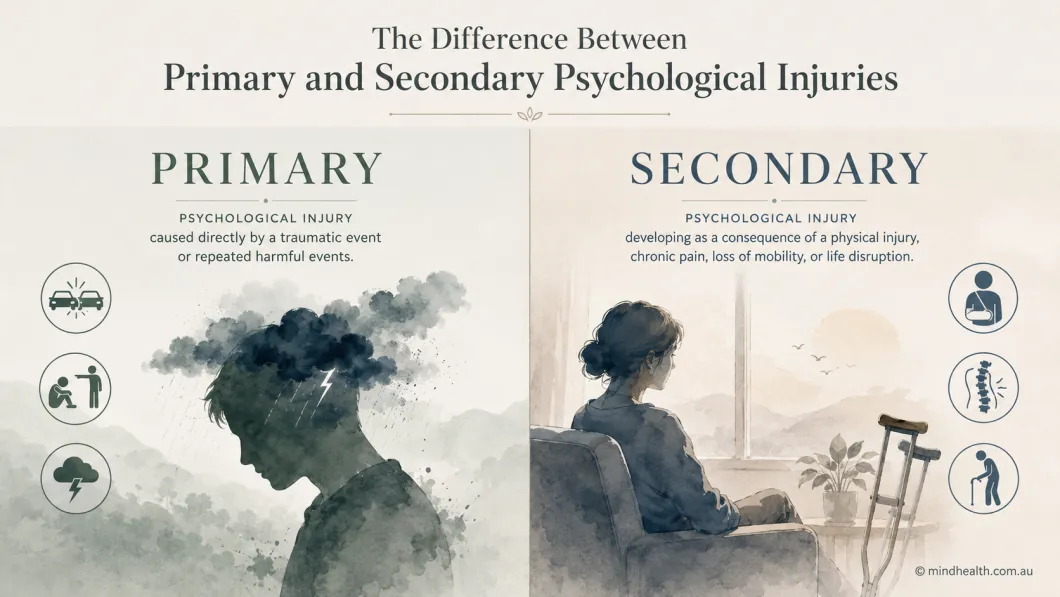
A primary psychological injury occurs when a direct, specific event, or a series of events, causes psychological distress. This might involve witnessing a traumatic workplace incident, experiencing a severe motor vehicle accident, or enduring prolonged workplace bullying.1 The psychological impact, which may present as acute stress, anxiety, or trauma-related symptoms, is the direct result of the event itself.
Conversely, a secondary psychological injury develops as a consequence of a physical injury.2 For instance, if you have sustained a severe back injury at work, you may experience chronic pain, loss of mobility, and a temporary inability to engage in activities you love. Over time, the strain of managing chronic physical pain and adjusting to these massive lifestyle changes can lead to significant psychological distress, such as deep sadness or anxiety regarding your future. Both forms of injury are highly valid, intensely impactful, and heavily supported by evidence-based psychological treatment.
Why work with an accredited SIRA and Comcare psychologist?
Choosing the right support network is crucial during your recovery. Navigating insurance systems like icare, SIRA (State Insurance Regulatory Authority), or Comcare requires more than just clinical expertise; it requires an understanding of the complex administrative frameworks that govern your claim.
Working with an accredited WorkCover psychologist or Comcare psychologist ensures that your practitioner is specifically trained to operate within these regulatory systems. At Mind Health, our accreditation means we are uniquely positioned to collaborate seamlessly with your Nominated Treating Doctor (NTD), your rehabilitation provider, and your case manager. Our primary focus is to deliver evidence-based, trauma-informed interventions that align with clinical guidelines, ensuring your recovery journey is both supported and transparent.
We understand that the claims process itself can inadvertently contribute to your stress. Research published by SIRA NSW points to early support and coordinated action as helpful for recovery, while also finding that the evidence does not yet clearly show which workplace-connected treatments work for most psychological injuries.4 Working with a professional who knows these schemes helps ensure that the administrative aspects of your psychological care are handled efficiently, allowing you to focus your energy entirely on your rehabilitation.
The Mind Health approach to trauma-informed recovery
At Mind Health, our philosophy is anchored in providing a safe, non-judgmental, and trauma-informed environment. When you attend our clinic for a CTP, SIRA, or Comcare claim, our first priority is to establish trust and ensure you feel heard. We do not rush the process; we recognise that healing occurs at a pace unique to every individual.

Our collaborative process begins with a comprehensive, compassionate assessment to deeply understand your unique experiences and the impact the injury has had on your daily life, relationships, and sense of self. Following this, we develop a tailored treatment plan utilising evidence-based therapies. This may involve cognitive-behavioural approaches to assist with pain management and anxiety, or trauma-focused therapies designed to process distressing memories safely.
Understanding how the nervous system responds to trauma is a central part of our treatment framework. We also draw on insights from our work on evidence-based stress management to equip you with practical, day-to-day coping tools.
Our ultimate goal is to empower you. We work to build your resilience, equip you with practical coping strategies, and support a safe, sustainable return to work and everyday life when you are ready.
Understanding the claims process for psychological injuries
One of the most significant sources of distress for injured workers is uncertainty about the claims process itself. Understanding the key steps can reduce anxiety and help you feel more in control of your recovery journey.
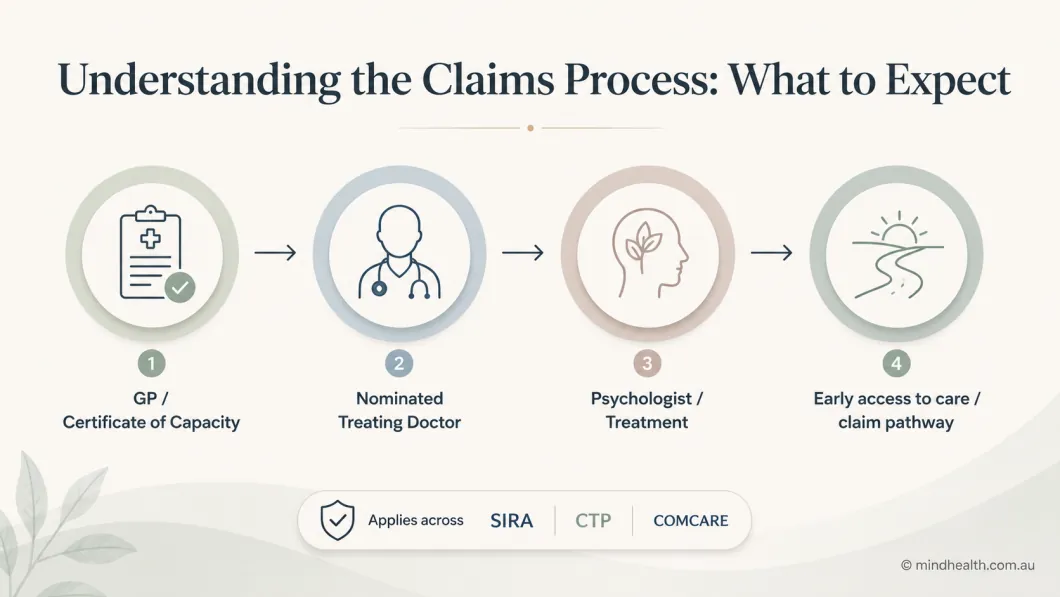
Under the NSW Workers Compensation system, your journey typically begins with a visit to your General Practitioner, who will issue a Workers Compensation Certificate of Capacity. This document is the gateway to accessing funded psychological treatment. Your GP will also identify a Nominated Treating Doctor (NTD) who coordinates your overall care. From there, a referral to an accredited psychologist such as those at Mind Health allows your psychological treatment to commence. For some claims, workers may receive interim payments and some funded treatment while the insurer is still deciding, so care can begin before the claim is formally determined. NSW workers compensation laws changed from 1 July 2026, so check the SIRA website or ask your insurer which arrangements apply to your claim.2
For CTP (Compulsory Third Party) claims arising from motor vehicle accidents, the process is governed by the Motor Accident Injuries Act 2017 in NSW. Psychological treatment is a recognised and funded component of CTP recovery, and early intervention is strongly encouraged by SIRA guidelines.
If you are a Commonwealth employee, Comcare administers your workers’ compensation claim under the Safety, Rehabilitation and Compensation Act 1988.3 Psychological injuries are fully recognised under this scheme, and Ahpra-registered psychologists, including those at Mind Health, can provide treatment under your claim.
The connection between burnout, workplace stress, and psychological injury
It is important to recognise that psychological injuries do not always arise from a single dramatic event. Cumulative workplace stress, sustained over months or years, can be just as damaging. Burnout, characterised by emotional exhaustion, depersonalisation, and a diminished sense of personal accomplishment, can also be damaging. In NSW, new requirements apply to primary psychological injuries first notified on or after 1 July 2026. To be compensable, the injury must be caused by a relevant event (such as bullying, sexual or racial harassment, excessive work demands, witnessing a traumatic incident, or acts or threats of violence), have a real and direct connection to employment, and have employment as the main contributing factor. These changes do not apply to secondary psychological injuries that arise because of a physical injury.2 Your GP, insurer or a lawyer can explain how this applies to you.
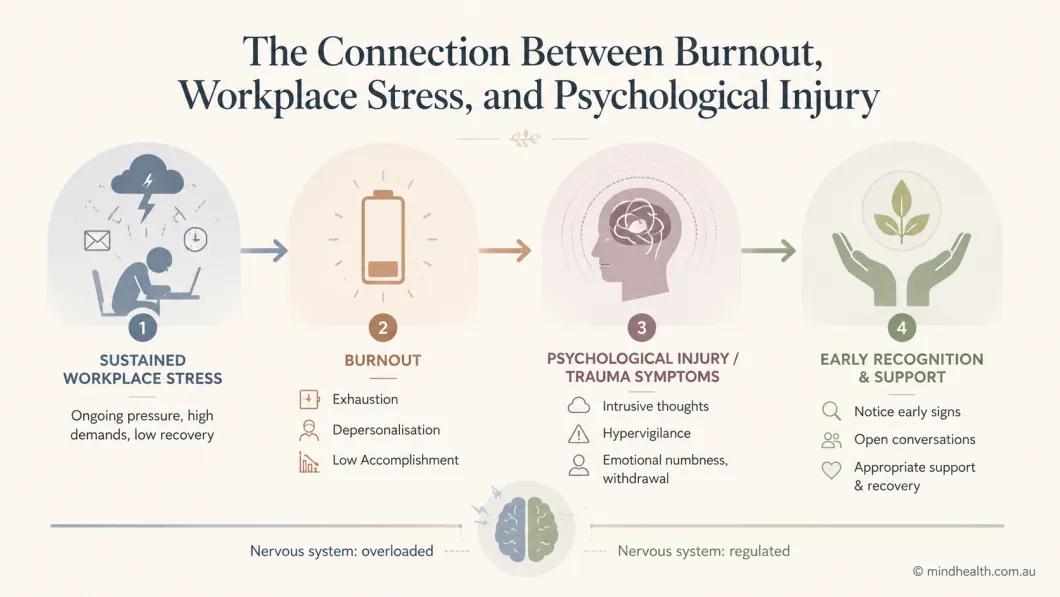
Similarly, the psychological aftermath of traumatic experiences can manifest in ways that are not immediately obvious. Intrusive memories, hypervigilance, avoidance behaviours, and emotional numbing are all hallmarks of post-traumatic stress that may emerge weeks or even months after the precipitating event. If you recognise any of these symptoms in yourself, seeking a professional assessment at the earliest opportunity is strongly advisable.
Frequently asked questions
Do I need an approved claim to start seeing a psychologist?
While an approved claim streamlines the billing process, you do not always need to wait for full approval to seek help. Under many SIRA and WorkCover guidelines, provisional liability may allow you to access early intervention psychological support. We recommend speaking directly with your GP or case manager, and you can also contact our Mind Health team to discuss how we can facilitate early support during the pending phase of your claim.
What happens in the first session with a workers’ compensation psychologist?
Your first session is entirely about creating a safe space to understand your current situation. We will gently discuss the background of your injury, how it is affecting your day-to-day life, and what you hope to achieve through therapy. We will also explain our confidentiality policies and how we communicate with your medical team to ensure your recovery is highly coordinated. You can read more about what to expect in a psychology session on our blog.
Is what I say in therapy completely confidential from my employer?
Confidentiality is a cornerstone of our psychological practice, strictly governed by Ahpra guidelines. While we do provide necessary progress updates and capacity certificates to your insurer and Nominated Treating Doctor to support your claim, the deeply personal details of our therapeutic conversations remain strictly confidential. We always discuss and agree upon what information will be shared before any reports are submitted.
How do you treat secondary psychological injuries caused by physical pain?
Secondary psychological injuries require a holistic approach. We utilise therapies specifically aimed at pain management, adjustment counselling, and cognitive restructuring. By addressing the grief of lost function and the anxiety of an uncertain future, we help clients build a new sense of identity and purpose that is not defined solely by their injury.
How long does psychological treatment for a workers’ compensation claim typically last?
The duration of treatment varies considerably depending on the nature and severity of the psychological injury, the individual’s personal circumstances, and the goals of therapy. Under SIRA guidelines, treatment is typically reviewed at regular intervals to ensure it remains clinically appropriate and goal-directed. Our psychologists work collaboratively with you and your treatment team to ensure that every session is purposeful and contributing meaningfully to your recovery.
Can I choose my own psychologist for a workers’ compensation claim?
In most cases, yes. Under NSW workers’ compensation and CTP schemes, you generally have the right to choose your treating psychologist, provided they hold the relevant accreditation. At Mind Health we work with people on workers compensation and CTP claims; ask us which of our psychologists can see you under your scheme.
What is the difference between SIRA, icare, and WorkCover?
These terms are often used interchangeably but refer to distinct entities. SIRA (State Insurance Regulatory Authority) is the NSW government body that regulates the workers’ compensation and CTP insurance schemes. icare (Insurance & Care NSW) is the government insurer that manages workers’ compensation claims for most NSW employers. WorkCover is a term that historically referred to the former WorkCover Authority of NSW and is still commonly used colloquially to describe the workers’ compensation system. Understanding these distinctions can help you navigate your claim more effectively.
Taking the next step
Experiencing a psychological injury can feel isolating, but you do not have to navigate the recovery and claims process alone. Working with a trauma-informed psychologist can help you get care suited to your recovery.
If you or someone you know is struggling following a workplace incident or motor vehicle accident, please reach out to us. Visit our Contact Page to schedule an initial consultation with one of our team at Mind Health. You can also call us directly on 1300 084 200.
References
- Safe Work Australia. (2024). Psychological health and safety in the workplace. https://data.safeworkaustralia.gov.au/sites/default/files/2024-02/Psychological-health-in-the-workplace_Report_February2024.pdf
- State Insurance Regulatory Authority (SIRA). (2026). For medical or health providers: workers compensation updates. https://www.sira.nsw.gov.au/workers-compensation/workers-compensation-reforms/for-health-providers
- Comcare. (n.d.). Psychological injury and mental health claims. Retrieved from Comcare.
- State Insurance Regulatory Authority (SIRA). (n.d.). Mental health (research activities). https://www.sira.nsw.gov.au/resources-library/our-research-activities/mental-health
Related reading
- Workers compensation psychology
- PTSD treatment and support
- Medico-legal psychology services
Get professional support
PTSD & trauma therapy at Mind Health
We offer EMDR, trauma-focused CBT, and other evidence-based approaches to help you work through trauma.
Medicare rebates available with a Mental Health Treatment Plan · Telehealth appointments Australia-wide
Helpful Australian resources
- Beyond Blue: Support for depression, anxiety and related conditions. Call 1300 22 4636.
- Lifeline Australia: Crisis support and suicide prevention. Call 13 11 14 (24/7).
- Medicare Mental Health: Australian Government mental health gateway. Call 1800 595 212.
- Black Dog Institute: Research-based resources on depression, bipolar disorder, and PTSD.
- SANE Australia: Support for people living with complex mental illness. Call 1800 187 263.
More on fees & access.
 Fees & Access
Medicare Mental Health Check In: Free support and where it fits
A plain guide to the free Medicare Mental Health Check In service: who it suits, what to expect,…
 Mind Health team10 min
 Fees & Access
How much does a psychologist cost in Australia? (2026 fees, rebates & gap fees explained)
Psychologist costs in Australia 2026: Medicare rebates, gap fees, NDIS, EAP and bulk billing explained. Make sense of…
Mind Health team12 min Fees & Access
NDIS psychology: What’s funded, how to access it and what to expect
A practical guide to accessing psychology through your NDIS plan, which support categories apply, what reports you need,…
Mind Health team7 min
Your next step starts here.
Tell us what's going on and we'll match you with the right psychologist, usually after a free triage. No referral needed to begin.
