 The referral pathways guide



 Read with intention













 Meet the clinicians
ADHD in women and girls: Why it is often missed and what assessment involves

Many women are well into adult life before anyone asks whether attention deficit hyperactivity disorder (ADHD) could be part of the picture.1 The question often comes up after a child is assessed, after years of treatment for anxiety or low mood, or when long-standing coping strategies stop working.
This article is for women and girls who wonder about ADHD, and for the parents, partners and GPs who support them. It covers why ADHD is often missed or recognised late, what it can look like at different ages, what an assessment involves in Australia, and what support looks like.
A note on language: most studies describe their participants as girls and women, or as female, so we use those words when describing findings. Experiences vary widely, including for trans and gender-diverse people, whose experiences of ADHD have had little research so far.1 Nothing here is a checklist for diagnosing yourself.
Key takeaways
- ADHD can be under-recognised in girls and women, and Australian clinical guidelines ask clinicians to keep this in mind.
- Common reasons include a quieter, inattentive presentation, masking, referral patterns shaped by stereotypes, and anxiety or low mood being treated first.
- In a Swedish study of more than 85,000 people with ADHD, females were diagnosed about four years later than males.
- Assessment is a thorough clinical process: an interview, your history from childhood, rating scales and information from people who know you. There is no single test.
- Support usually combines several things: learning about ADHD, cognitive behavioural strategies, practical skills and, for some people, medication discussed with a doctor.
How common is ADHD, and who gets diagnosed?
ADHD is a neurodevelopmental condition. It involves patterns of inattention, hyperactivity and impulsivity that get in the way of daily life.2 In Australia it affects about 6 to 10% of children and adolescents and 2 to 6% of adults.3 Australian clinical guidelines, published in 2022, ask clinicians to keep in mind that ADHD can be under-recognised in girls and women.34
The gap shows up in who gets diagnosed, and when. In childhood, ADHD is about 2 to 2.5 times more common in boys than in girls. Among adults with a diagnosis, the ratio narrows to about 1.5 to 1 or lower.5 Children referred to clinics are split more unevenly again, with between 3 and 16 boys for every girl.6 Taken together, these figures suggest that many girls with ADHD are not identified until they are adults.
A study of 85,330 people with ADHD in Stockholm points the same way. Females were, on average, 23.5 years old when ADHD was first recorded, compared with 19.6 years for males: a gap of about four years. Before and after that point, they also had more mental health diagnoses and more contact with health services than males with ADHD.7
Australia has its own evidence. A Senate inquiry into ADHD assessment and support services reported in November 2023 after hearing from women who had been diagnosed late or overlooked. Submitters also told the inquiry that misdiagnosis and late diagnosis are common for gender-diverse people.1
So if you were a quiet, capable student and are only now wondering about ADHD, the timing is not unusual, and it is not a reason to dismiss the question.
Why ADHD is often missed in women and girls
There is rarely one reason. Several tend to overlap.
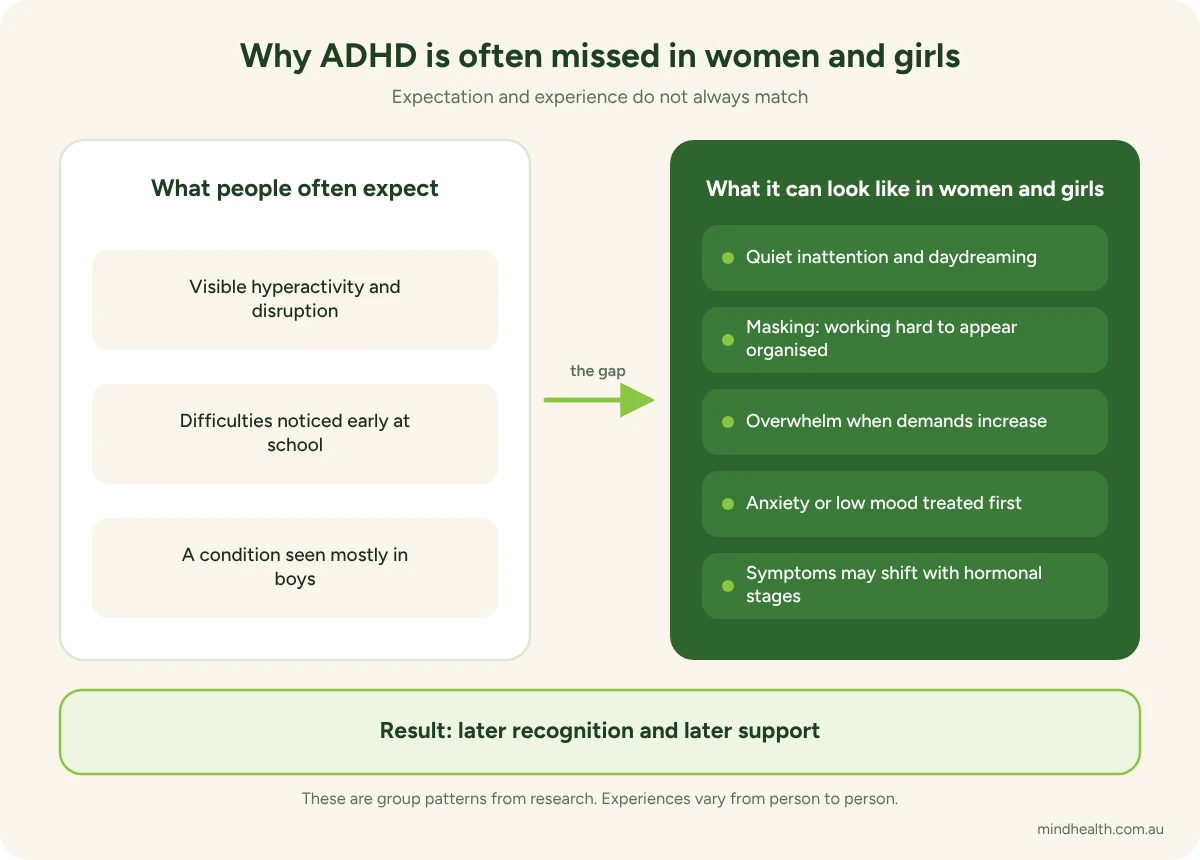
- A quieter presentation: Girls and women with ADHD are more likely to have mainly inattentive symptoms than obvious hyperactivity.5 A girl who drifts off in lessons, loses her things and hands work in late disrupts no one, so she is less likely to be referred than a child who cannot stay seated.6
- Stereotypes and referral patterns: ADHD is still widely pictured as a disruptive young boy, and that picture influences who adults think to refer.6 Questionnaires filled in by parents and teachers may also under-report ADHD behaviours in girls.5
- Masking and compensating: Some girls and women become skilled at hiding their difficulties with coping strategies, such as leaning heavily on lists and alarms or staying up late to finish what others did during the day. These strategies can be useful, but they take effort, and they can lead other people to underestimate how hard things are.6 In one Australian community survey reported to the inquiry, 86% of more than 570 respondents said they had tried to mask or hide their ADHD at school or work.1
- Anxiety or low mood treated first: Anxiety and depression often occur alongside ADHD.3 They can also be what a person first seeks help for, and it is not unusual for an adult with ADHD to be treated for anxiety or depression first.6 Treatment for anxiety or depression is still worthwhile. If it has helped only partly, it is reasonable to ask whether attention and organisation have been lifelong difficulties too.
- Hormonal stages: ADHD symptoms may feel stronger at times of hormonal change, such as parts of the menstrual cycle, pregnancy and menopause.6 The research is still thin. A 2025 systematic review found only 11 studies, often with small samples. They pointed to a link between sex hormones and ADHD symptoms during puberty and across the menstrual cycle, and the reviewers called for more research, including on menopause.8 If you notice a pattern, brief notes kept over a month or two give your GP or psychologist something concrete to work with. See also our article on perimenopause and mental health.
What ADHD can look like across life stages
These are patterns seen across groups, not a profile of any one person, and none is unique to ADHD.
Childhood
In primary school, ADHD in girls may show up as daydreaming, distraction, disorganisation or seeming not to try, more than as behaviour problems. School reports may carry comments such as “easily distracted” or “could try harder”. A structured, supportive home or classroom can keep difficulties out of view.6
Teenage years
High school asks for more planning, organising and juggling of assignments. Some girls with ADHD start to feel overwhelmed at this point, and self-esteem can suffer. Some respond with anxiety about schoolwork, or with perfectionism as a way to compensate. Friendships can also become harder to keep up.6
Adulthood
Work, study and family life all lean on attention and organisation. Women with ADHD may notice forgetfulness, disorganisation and strain in relationships with colleagues. Some women recognise the pattern themselves and raise it with their GP.6
These difficulties are not a sign of laziness or lack of care, and they sit alongside each person’s strengths. If parts of this sound familiar, it helps to note when each difficulty started and where it shows up, such as at home, at work or in study. ADHD affects more than one area of life, so those details are useful in an assessment.3
What an assessment involves, and who does what
No blood test or other biological test can confirm ADHD.2 A diagnosis rests on a thorough assessment by an appropriately trained clinician.3 An assessment usually includes:
- A clinical interview: Your current difficulties, when they began, how severe they are and how they affect study, work and relationships.4
- Your history: Development, health, family, education and any earlier treatment.4
- Rating scales and questionnaires: Completed by you and, where possible, by someone who knows you well, such as a parent or partner.2
- Other explanations and co-occurring conditions: Anxiety, depression and sleep problems can resemble ADHD or occur with it, so a careful assessment checks for these.3
For girls and women, a careful assessment also asks about quieter symptoms and about the coping strategies that may be hiding them, because old school reports can miss both.6 It can help to tell the clinician what it costs you to keep up, not only how well you appear to manage.
Who does what
- Your GP: Usually the first conversation. A GP can check for other health causes, talk through options and refer you on.
- Psychologists: Carry out assessments and provide psychological therapy.2 You can read about ADHD assessment at Mind Health.
- Psychiatrists and paediatricians: Medical doctors who assess and diagnose ADHD,2 and who can discuss treatment options, including medication, with you.
- GPs with additional training in NSW: Since 1 September 2025, GPs authorised as continuation prescribers have been able to keep prescribing for people who already have a diagnosis and are stable on their medication. NSW Health has also announced that, from late October 2026, GPs with further training, called GP endorsed prescribers, will be able to assess and diagnose ADHD in people aged 6 years and over. Not every GP takes part, so ask your regular GP first.2 Our guide to the NSW GP reforms has more detail.
Until these reforms, ADHD in NSW has been diagnosed by a paediatrician, psychiatrist or psychologist.2 Whether medication is suitable is a decision to make with your doctor. Access can be slow: the 2023 inquiry heard that waits for an initial appointment were typically between six and 18 months,1 so it is worth asking about waiting times when you are referred.
What psychological support involves
Australian clinical guidelines recommend a combination of supports matched to the person, not a single treatment.3 Psychological and practical supports aim to reduce the day-to-day impact of ADHD, and they can help with wellbeing and self-esteem as well as symptoms.4 They can include:
- Understanding ADHD: Learning how ADHD shows up for you, and looking again at old labels such as “lazy” or “careless”. Work on self-esteem and identity is part of this.4
- Cognitive behavioural strategies: The guidelines recommend offering cognitive behavioural approaches to adolescents and adults with ADHD, while rating the certainty of the evidence as low.3 These approaches, related to cognitive behavioural therapy (CBT), include strategies to compensate for cognitive difficulties, support with managing emotions, and skills for handling stress.4 One example is breaking a large task into small steps, each with its own start time.
- Coaching-style skills: ADHD coaching can be part of a treatment plan, although the research behind it is limited.3 It is a collaborative process, led by your own goals, that combines learning about ADHD with skills practice.4 In practice this can mean building routines, reminders and planning systems that suit you.
- Daily foundations: Guidance on sleep, diet and physical activity.3
- Co-occurring difficulties: Support for anxiety, low mood, relationships and speaking up for what you need at school or work.4
Some people use psychological support on its own, and some combine it with medication. Psychological therapies and medication usually work better together than either does alone.2 Decisions about medication are ones to make with your doctor.
When to see your GP or a psychologist
Consider talking with your GP or a psychologist if any of these sound familiar:
- Long-standing difficulties: Problems with attention, organisation or restlessness have been present since childhood and affect study, work, home life or relationships.
- An incomplete explanation: You have had treatment for anxiety or depression and still feel that something is unexplained.
- High effort: Keeping up takes far more effort than it seems to take others, and you are often exhausted.
- Concerns about your child: Teachers have described your daughter as distracted, disorganised or anxious over several years.
It can help to bring specific examples, old school reports and a family member’s observations. Your GP can also talk with you about whether a Mental Health Treatment Plan (MHTP) is suitable for psychological therapy. If things feel urgent or you are worried about your safety, please seek prompt help from your GP or a health service.
Frequently asked questions
Is ADHD different in women and girls?
Girls and women with ADHD are more likely to have mainly inattentive symptoms than visibly hyperactive behaviour, and anxiety or low mood often sit alongside. Any presentation is possible in any person, so these are group patterns, not rules. Experiences vary widely, including for trans and gender-diverse people, whose experiences have had little research so far.
Why is ADHD often diagnosed later in women?
Quieter inattentive symptoms are easy to overlook, coping strategies can mask difficulty, stereotypes shape who is referred, and anxiety or depression is often treated first. In a Swedish study of more than 85,000 people with ADHD, females were diagnosed about four years later than males on average. Australian clinical guidelines ask clinicians to keep under-recognition in girls and women in mind.
Could it be anxiety or depression instead of ADHD?
It could be either, or both. Anxiety and depression often occur alongside ADHD, and they can resemble it. A careful assessment looks at when difficulties began, where they show up and what else might explain them. Treatment for anxiety or low mood remains worthwhile whatever the outcome of an assessment.
Who can diagnose ADHD in NSW?
In NSW, ADHD has been diagnosed by a paediatrician, psychiatrist or psychologist. Under announced state reforms, GPs with further training, called GP endorsed prescribers, will also be able to assess and diagnose ADHD in people aged 6 years and over from late October 2026. Not every GP takes part, so ask your regular GP first. Questions about medication are for your doctor.
Do hormones affect ADHD symptoms?
Possibly. A 2025 systematic review found 11 studies pointing to a link between sex hormones and ADHD symptoms during puberty and across the menstrual cycle. The studies often had small samples, and more research is needed, including on menopause. If your symptoms seem to shift with your cycle or in perimenopause, mention it to your GP or psychologist.
References
- Senate Community Affairs References Committee. (2023). Assessment and support services for people with ADHD (Chapter 3: Barriers to assessment and diagnosis). Parliament of Australia. https://www.aph.gov.au/Parliamentary_Business/Committees/Senate/Community_Affairs/ADHD/Report/Chapter_3_-_Barriers_to_assessment_and_diagnosis
- NSW Health. (2026). ADHD (current as at 19 October 2026). NSW Government. https://www.health.nsw.gov.au/adhd/Pages/default.aspx
- May, T., Birch, E., Chaves, K., Cranswick, N., Culnane, E., Delaney, J., … Bellgrove, M. (2023). The Australian evidence-based clinical practice guideline for attention deficit hyperactivity disorder. Australian and New Zealand Journal of Psychiatry, 57(8), 1101-1116. https://doi.org/10.1177/00048674231166329
- Australasian ADHD Professionals Association. (2022). Australian evidence-based clinical practice guideline for attention deficit hyperactivity disorder (ADHD) (1st ed.). AADPA. https://adhdguideline.aadpa.com.au/
- Hinshaw, S. P., Nguyen, P. T., O’Grady, S. M., & Rosenthal, E. A. (2022). Annual research review: Attention-deficit/hyperactivity disorder in girls and women: Underrepresentation, longitudinal processes, and key directions. Journal of Child Psychology and Psychiatry, 63(4), 484-496. https://doi.org/10.1111/jcpp.13480
- Young, S., Adamo, N., Ásgeirsdóttir, B. B., Branney, P., Beckett, M., Colley, W., … Woodhouse, E. (2020). Females with ADHD: An expert consensus statement taking a lifespan approach providing guidance for the identification and treatment of attention-deficit/hyperactivity disorder in girls and women. BMC Psychiatry, 20, 404. https://doi.org/10.1186/s12888-020-02707-9
- Skoglund, C., Sundström Poromaa, I., Leksell, D., Ekholm Selling, K., Cars, T., Giacobini, M., Young, S., & Kopp Kallner, H. (2024). Time after time: Failure to identify and support females with ADHD, a Swedish population register study. Journal of Child Psychology and Psychiatry, 65(6), 832-844. https://doi.org/10.1111/jcpp.13920
- Osianlis, E., Thomas, E. H. X., Jenkins, L. M., & Gurvich, C. (2025). ADHD and sex hormones in females: A systematic review. Journal of Attention Disorders, 29(9), 706-723. https://doi.org/10.1177/10870547251332319
Related reading
- 5 signs it’s not just “stress”: The hidden symptoms of adult ADHD
- Beyond the “deficit”: The neuroscience & lived reality of adult ADHD
- What is a psychological assessment? What to expect in Australia
This article is general information only and is not a substitute for personal advice from a qualified health professional. If you are concerned about your mental health, please speak with your GP or a psychologist.
Free · 5 to 10 minHow are you going, really?Take the Mind Health Check: a few short questions, then a private report.
More on ADHD & neurodiversity.
 ADHD & Neurodiversity
NSW GPs and ADHD diagnosis: What the reforms mean for you
What the NSW ADHD reforms change, who they cover, and where a comprehensive psychological assessment still fits if…
Mind Health team10 min ADHD & Neurodiversity
Adult autism diagnosis in Australia: What to expect, how to get assessed, and what comes next
Exploring adult autism diagnosis in Australia: assessment pathways, costs, Medicare options, and what a late diagnosis can mean…
Mind Health team12 min ADHD & Neurodiversity
Beyond the “deficit”: The neuroscience & lived reality of adult ADHD
It’s not just about being distracted. A deep dive into the neuroscience reality of Adult ADHD, and the…
Mind Health team7 min
Your next step starts here.
Tell us what's going on and we'll match you with the right psychologist, usually after a free triage. No referral needed to begin.
