 The referral pathways guide



 Read with intention












 Meet the clinicians
Multicultural mental health in Australia: Why culture matters in therapy

Australia is one of the most culturally diverse nations in the world. Greater Western Sydney is home to Parramatta and the communities we serve at Mind Health, and more than half its population was born overseas or has parents who were. Over 200 languages are spoken across the region.
This diversity is a source of profound social richness. It is also a reality that mainstream mental health services have not always responded to well.
For many people from Culturally and Linguistically Diverse (CALD) backgrounds, seeking psychological help can involve navigating layers of complexity that go well beyond scheduling an appointment. This article explores why culture matters so much in mental health. It also asks what culturally informed psychological care actually looks like.
Key takeaways
- Culture shapes how distress is experienced, expressed, understood, and whether help is sought.
- Most evidence-based therapies were developed in individualist cultures and may need adapting.
- Culturally informed care works within a client’s values and explanatory framework, not against them.
- Cultural humility, language access and flexible formats matter more than sharing the same background.
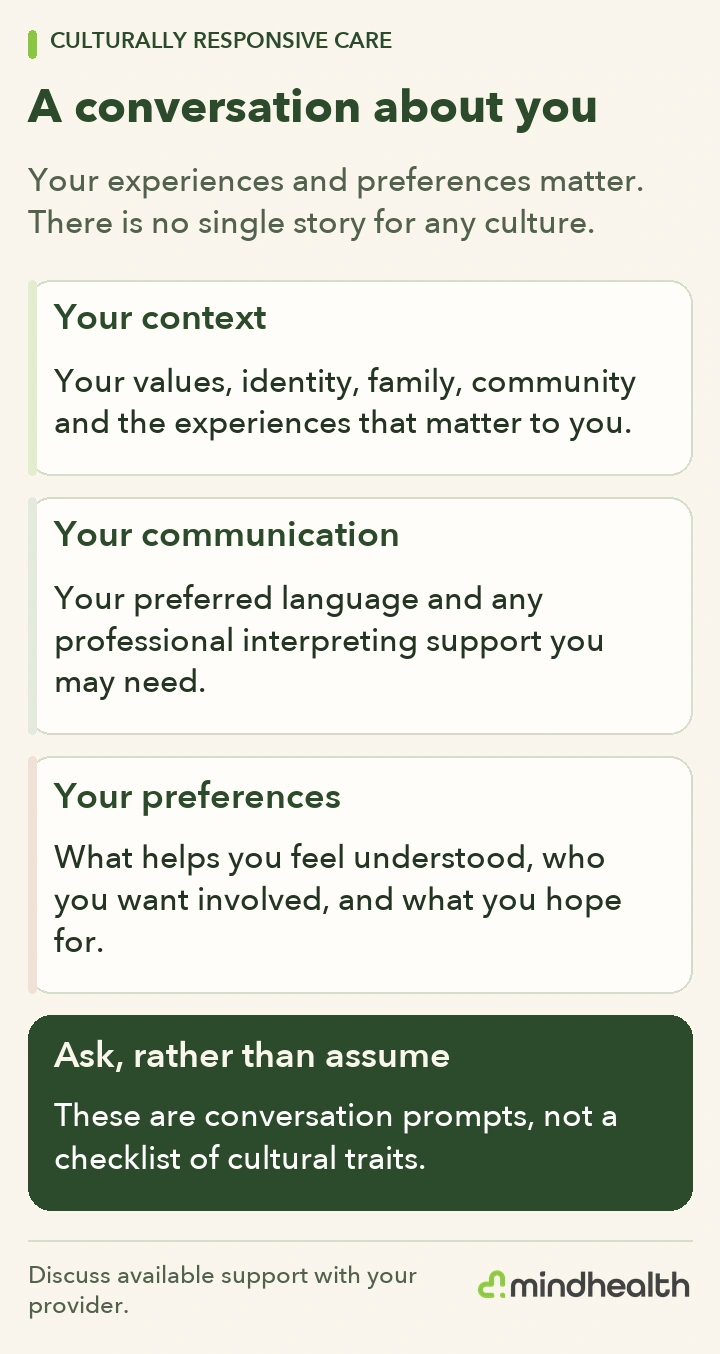
How culture shapes mental health
Culture shapes everything about how we experience and express distress, what we believe causes it, whether we seek help, and what kind of help we believe will work.
Collectivist versus individualist values
Western psychological models, including most evidence-based therapies, were developed within largely individualist cultural frameworks, where personal autonomy, individual wellbeing, and self-expression are central values.
For people from collectivist cultural backgrounds (including many South Asian, East Asian, Middle Eastern, Pacific Islander, and African communities), the individual self is understood in relation to family, community, and social roles. Distress is often experienced and expressed through this relational lens. “How can I manage my own anxiety” may feel like a strange question when the primary concern is “how do I meet my obligations to my family while not burdening them?”
A culturally sensitive approach doesn’t pathologise collectivist values. It works within them.
Stigma and shame
Mental health stigma is the belief that psychological distress reflects weakness, failure, or character defect. It is present in all cultures, but its weight and form vary significantly. In some communities, seeking professional mental health support is associated with deep shame, not just for the individual but potentially for the family.
For many people from communities where stigma is particularly prominent, the barrier to seeking help is not lack of awareness. It is the calculation of what seeking help might cost in terms of family reputation, community standing, and self-perception.
Effective therapy acknowledges and explores this. Rather than dismissing stigma-related concerns as irrational, it helps the person navigate them with support and in a way that respects their community context.
Explanatory models of distress
Different cultural traditions have different explanatory models for psychological distress. Each offers its own framework for understanding what is wrong and what needs to happen to restore wellbeing.
Some communities understand distress through a spiritual or religious lens (a test from God, spiritual imbalance, the result of unresolved ancestral issues). Others frame it in physical or somatic terms. In many languages there is no exact equivalent for “depression” as a mental state, but there are rich vocabularies for heart heaviness, bodily depletion, or loss of vitality.
These frameworks are not wrong. They are ways of making meaning. A culturally informed psychologist does not require a client to abandon their explanatory framework and adopt a Western one. They work to find language and approaches that bridge between frameworks.
Acculturation stress and intergenerational dynamics
Even when it is a chosen and positive transition, migration itself is a significant psychological stressor. The process of adapting to a new culture (acculturation) involves navigating:
- Language barriers and the cognitive load of operating in a second or third language
- Loss of familiar social networks and community
- Changed roles, particularly when children acculturate faster than parents, which creates intergenerational cultural tension
- Discrimination, whether overt or subtle
- Grief for the places, people and roles left behind, and for a version of oneself that belonged in another context
Refugees and people who have experienced forced displacement carry additional layers, including exposure to violence, loss, persecution, and often ongoing insecurity about residency status.

First Nations Social and Emotional Wellbeing
For Aboriginal and Torres Strait Islander Australians, psychological wellbeing is understood within a distinct framework: Social and Emotional Wellbeing (SEWB). This framework recognises the indivisible connections between an individual and their body, mind, family, community, Country, culture, and spirituality.
Through a history of institutional harm, the ongoing trauma of colonisation, and services that have not been culturally safe, Western mental health frameworks have historically failed First Nations people in Australia.
Culturally safe mental health support for Aboriginal and Torres Strait Islander people is built on connection to culture and Country as a foundation of wellbeing, recognition of intergenerational trauma, community-led and controlled approaches, and genuine relationship and trust.
Mind Health is committed to working respectfully with First Nations clients and to continuing to learn about culturally safe practice. We acknowledge the Dharug people as the Traditional Custodians of the land on which our Parramatta practice is located.
What culturally informed psychology looks like in practice
Culturally informed (or culturally responsive) psychology is not simply using a translator, or learning a few phrases in another language, or making assumptions about a person based on their cultural background.
It involves:
Cultural humility. This is an ongoing, reflective posture of curiosity and openness toward the client’s cultural context, rather than assumption of knowledge.
Working with the client’s explanatory framework. This means understanding what the client believes is wrong and what they believe will help, and building a therapeutic relationship that bridges this with evidence-based approaches.
Acknowledging structural determinants of distress. Poverty, discrimination, housing insecurity, and systemic disadvantage are genuine contributors to mental health difficulties. A culturally informed therapist recognises these and does not pathologise responses to genuinely difficult circumstances.
Language access. Where language is a barrier, this means using professional interpreting services rather than requiring family members (particularly children) to interpret sensitive material.
Flexibility of format. This means recognising that a 50-minute individual talking therapy session may not be the most culturally resonant format for everyone. Family involvement, group approaches, or community-connected support may be more appropriate for some clients.
Awareness of the therapist’s own cultural position. All therapists bring their own cultural assumptions, values, and blind spots. Culturally informed practice involves ongoing examination of these.
Finding a culturally informed psychologist
When seeking a psychologist, it is entirely appropriate to ask:
- “Do you have experience working with clients from [your background]?”
- “What languages do you or your colleagues speak?”
- “How do you approach cultural differences in your clinical work?”
You do not need to find a psychologist who shares your cultural background. For some people and some presentations cultural match is important, but what matters more is genuine cultural curiosity, humility, and a willingness to follow the client’s lead.
At Mind Health in Parramatta, our clinical team includes psychologists with diverse cultural and linguistic backgrounds, and we work with clients from a wide range of cultural communities across Western Sydney and via telehealth.
Frequently asked questions
Why does culture matter in mental health and therapy?
Culture shapes how we experience and express distress, what we believe causes it, whether we seek help, and what help we expect to work. Most evidence-based therapies were developed within individualist frameworks, so they may need adapting for people from collectivist backgrounds where the self is understood in relation to family and community. Culturally responsive care works within a person’s values rather than dismissing them.
What is culturally sensitive therapy?
Culturally sensitive, or culturally responsive, therapy is more than using a translator or learning a few phrases. It involves cultural humility, working with the client’s own explanatory framework for distress, acknowledging structural factors like discrimination and disadvantage, using professional interpreters where needed, offering flexible formats such as family involvement, and the therapist reflecting on their own cultural assumptions and blind spots.
Do I need a psychologist from my own cultural background?
Not necessarily. For some people and presentations, cultural match matters, but what matters more is genuine cultural curiosity, humility, and willingness to follow the client’s lead. It is entirely appropriate to ask a psychologist whether they have experience working with clients from your background, what languages their team speaks, and how they approach cultural differences in their clinical work.
How does stigma affect help-seeking in some communities?
Mental health stigma exists in all cultures but varies in weight and form. In some communities, seeking professional support carries deep shame, not only for the individual but potentially for the family. Often the barrier is not lack of awareness but a calculation of the cost to family reputation and standing. Effective therapy explores these concerns respectfully rather than dismissing them as irrational.
What is Social and Emotional Wellbeing for First Nations people?
Social and Emotional Wellbeing (SEWB) is a framework that understands wellbeing for Aboriginal and Torres Strait Islander people through the connections between an individual and their body, mind, family, community, Country, culture and spirituality. Culturally safe support recognises intergenerational trauma and the harms of colonisation, and is grounded in connection to culture and Country, community-led approaches, and genuine trust.
Related reading
This article is for informational purposes only and is not a substitute for professional mental health advice.
Get professional support
Talk to a psychologist at Mind Health
If you’re struggling with your mental health, our psychologists are here to help.
Medicare rebates available with a Mental Health Treatment Plan · Telehealth appointments Australia-wide
Helpful Australian resources
- Beyond Blue: Support for depression, anxiety and related conditions. Call 1300 22 4636.
- Lifeline Australia: Crisis support and suicide prevention. Call 13 11 14 (24/7).
- Medicare Mental Health: Australian Government mental health gateway. Call 1800 595 212.
- Black Dog Institute: Research-based resources on depression, bipolar disorder, and PTSD.
- SANE Australia: Support for people living with complex mental illness. Call 1800 187 263.
More on therapy & sessions.
 Therapy & Sessions
Psychologist vs psychiatrist vs counsellor: What’s the difference in Australia?
Confused about psychologists, psychiatrists and counsellors in Australia? Understand qualifications, Medicare rebates, and who to see first.
Mind Health team11 min Therapy & Sessions
What actually happens in a psychology session (and why it’s nothing like the movies)
Discover what really happens in a psychology session. No couches or tell me about your mother, just honest,…
 Bülent Ada11 min
 Therapy & Sessions
What is DBT? Dialectical behaviour therapy explained for Australians
DBT therapy goes well beyond borderline personality disorder. Understand the four skill modules, what a programme looks like,…
Mind Health team12 min
Your next step starts here.
Tell us what's going on and we'll match you with the right psychologist, usually after a free triage. No referral needed to begin.
